Tuesday, February 8, 2011

School Days--The Writing On the Wall


...And we are looking at a construction site, because....?

There's been a large construction site next to the elementary school for a year and a half or so now--lots of kids walk by it every day.  So you'd expect to eventually see that pristine white wall covered with graffiti...right?  Well...sort of.  You see something on that wall, right?  Here's a closer look:


...that's a nice drawing, isn't it?  I liked it--that's why I took a picture of it.


Here's another one:


Awww...carp streamers!  And an anime-style girl, both nicely drawn.

Another one I liked...


....a detailed dragon!


Can you see in these pictures that I've taken of the construction wall, that the drawings are not actually on the wall?  That is to say, they are not graffiti?

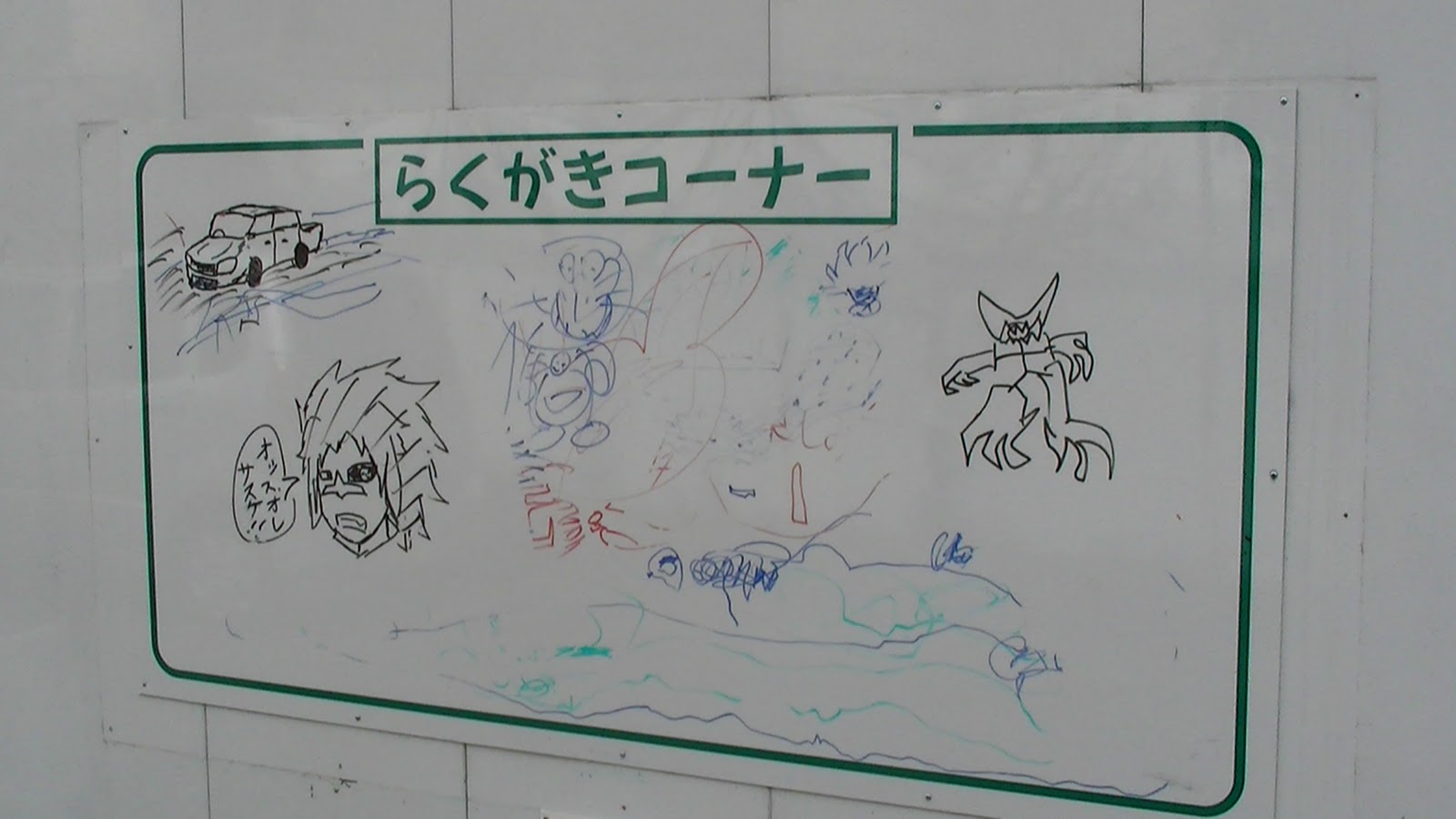
Here's what the kids are actually drawing on:


A white board--there are two of them, in fact.  The legend at the top says "Drawing Corner".

Somebody had the brilliant foresight to realize that a looong white wall like that was bound to shout out to kids "Draw on me!", and put up a couple of white boards...

...and whiteboard markers (there are always several markers in different colors), with a sticker on the holder that says "Everybody's Markers".

Ok...so why aren't the whiteboards just filled with rude pictures and words?

Because they take photos of the really good (or cute, in the case of the first graders) drawings and post them permanently on the wall for everyone to see and enjoy.  Go look at that top picture again--see all the drawings posted all the way down the construction wall?  Kids are kids, so I'm pretty sure not every single drawing is innocent and pure--but the non-offensive good drawings are the ones that get photographed, laminated, and posted.


Somebody is *really* good at drawing Pokemon characters!


...awwww.  First graders drawing Doraemon (Gadget Cat from the Future, in blue), and anime-style girly-girls ("I'm Anri!"). 


I walk by and check from time to time to see if there are new drawings up.  Every time I look at that wall, all I can think is--what a smart end run around inevitable behavior!  Japanese parents and teachers are incredibly good at positively interpreting what children are doing.  They always seem to me to do this instinctively.  I've tried to pick up on it.  My instinct is nearly always negative--and it leads to arguments or anger or punishment that maybe wouldn't have happened if I'd assumed a positive motive.  Kids, for example, like to grab mom's keys.  I used to demand that they give them to me (assuming they would lose my keys, or drop them in the toilet, or some such).  A much better way to get those keys back?  Look as genuinely surprised as you can, smile broadly, and say "Oh!  You *found* mommy's keys!  Thank you!  Mommy was looking everywhere!  Thank you!"...all while holding your hand out.  Toddlers will look confused, then echo your smile, then drop those keys right into your hand.  The same kind of generally positive spin on behavior works with older kids, too.  Those white board were a way of saying "Hey!  You all draw so well, please come and draw some pictures for us that we can put up!  Thank you!"....so the kids came and drew pictures instead of graffiti.  It always makes me think of zen master Shunryu Suzuki--"If you want to control your cow, put him in a wide field and watch him."  In other words, only by observing and watching first can you know when and how to help or what kind of instruction to offer.  I'm not sure, though, whether Japan is infused with Zen ideas, or whether Zen--after coming to Japan--became infused with Japan... 

Mata asobou, ne!

Monday, February 7, 2011

Monday Manglish--Kitteh Characters


The title of the above video (for maximum laffs) is "Store Manager Leon:   Goalkeeper"...Kawaii, desho!

Cute--but not actually the point of this post, which is Manglish...and why you shouldn't put your implicit trust in Google Translator;-))

Here is the Translator version of Leon's character description from the NekoCafe Leon website:

The temperature" signs son (?) You Leon. ちょっと頼りなさそうに見えちゃう、 Are unlikely to rely on my eyes a little
くるみ型の瞳は思わずギュッと守ってあげたくなっちゃう。 Walnuts type eyes tight gonna keep having her involuntarily.
ちなみにチャームポイントはマンチカン種特有の短い足。 Charm Point Munchkin species-specific way, short legs.
てふてふと歩いている姿は見る人すべてをメロメロにしちゃいます。 Chaimasu Tefutefu is walking with her to everyone who's drunk.

??

I may not be the best J-E translator in the world, but I'm fairly certain that given an uninterrupted half-hour (which, by the way, are hard to come by around here...), I could produce a translation that would at least sound more-or-less like, well, English instead of a dead-drunk Salaryman with his necktie around his head trying out his high school English on passing foreigners...  Maybe.;-))

Half An Hour And One Slice Of Strawberry Tart Without So Much Rat In It Later*...

 "Cafe Leon's Posterboy Leon!  I can hardly believe my eyes...
Walnut-shaped eyes squeezed tightly shut, I want to protect you...
Short legs are the special charming point of the Munchkin breed.
His waddling stride melts everyone's hearts.

...or something like that;-))

Where Google Translator goes off the rails is really the same way that first-year foreign language students do-- by making literal, word-by-word translations utterly innocent of context.  When I taught German, I didn't *let* the first-year kids use a bilingual dictionary when they were writing.   Most words have multiple meanings, and the way you choose the right word is by knowing the context in which it will be used.  Google Translator (useful as it surely is for straightforward timetables or price-guides and such in Cyrillic or Greek or Japanese even) is, in the end, a machine that doesn't appear to be programmed to understand context or slang in human language (which is, I can assure you, a HUGE undertaking).

But, even better than silly translations, I got this awesome Haiku from Official Haiku Maker Jerry, who said he'd write one for me if I hauled out my Kanji dictionary to improve upon Google Translate...

 Leon, the store boss
Like a prairie dog he stands
Dwarf, tall in spirit 


*Love!*
 
Mata asobou, ne! 

*Monty Python...can't for the life of me remember which sketch.

Sunday, February 6, 2011

I Haz Coffz: O-chazuke for a Cold

umeboshi-chazuke:  a popular snack


There's nearly always some rice in the rice cooker--and heaven forbid throwing any of it away!  Every grain of rice has seven gods, as the saying goes.  Mottainai!...as my mother-in-law goes;-))  That means "don't waste", and O-Baasans say it a lot (and moms, too, for that matter).  My husband introduced me to this just after we got married.  It took no getting used to--I liked it right away.


What is "it"?  O-Chazuke!  This is one of the simplest and most popular, homey snacks in Japan.  Leftover rice (still warm, or cold, it doesn't matter)... and hot green tea poured over it is the basic way to make it.   But there are also dry packaged versions, as in the top photo, containing the green tea in dry form, plus nori and sprinkles (the little brown balls) and sometimes a flavor--umeboshi (pictured), or salmon.  I'm personally fond of the umeboshi (pickled plum like you see sometimes on top of rice)...

Dekiagari!  (ready!)

....boil some water, sprinkle one pack on top of your leftover rice, pour hot water over.  Oishiiiii!  This tastes particularly good to me when I have a cold--which is why I ate this today for lunch.  Not much appetite, coughing, sneezing--O-Chazuke is soothing to a raw throat or a cough, and it's a hot liquid that helps a stuffy nose.  This may sound weird, but--trust me, it's GOOD!  If you have an Asian market nearby, look around for that packaging--even if you buy some and don't use it often, it has a nearly infinite shelf-life.

Saturday, February 5, 2011

An Afternoon at the NekoCafe Leon

Leon of the eponymous NekoCafe in Yokohama


At the request of a regular reader here, I have betaken myself and the kids (intrepid reporter that I am) to the Neko Cafe Leon in Yokohama.  Yes, there really is such a thing--a coffee shop with a separate room filled with kitties to play with...for a sizable chunk of change ($6 each for 30 minutes, and an additional $2/10min each after that--and you have to buy at least a drink).

click any photo to enlarge!
 The main attraction of this particular cafe is a Munchkin Cat named Leon (right and above).  He was asleep when we were there, but I could see that his legs really are that short.  I had no idea that there was such a thing as a Wiener Cat...  Leon appears to be a Scottish Fold Munchkin, given his short, folded-back ears.  (The short legs are the result of a naturally occurring mutation similar to the one giving dachshunds and corgis their short legs.)


...this poster of Leon was hilarious.  It says "I turn into a Prairie Dog when I stand up!",  and the white cat is thinking "Now you're the same size as me!"

Leon, in fact, is more than an attraction--the cafe website lists him as Ten Cho--Store Manager, whereas all the other kittehs are Staff...

Here's some video footage of Leon awake and walking around and playing with one of the Abyssinians:


(that's not my video--Leon was asleep while we were there...but it's a cute video, and it gives an idea of how munchkin kittehs move around.)


The NekoCafe was crowded the Saturday we went--we had to leave our name and take a walk while waiting to get in (about a 25 minute wait, though the waiter had said the wait could be up to an hour).  Fortunately Cafe Leon is just around the corner from Ishikawacho Station in the heart of Yokohama--and Yokohama's Chinatown is just on the other side of the station.

One of the Chinatown gates is pictured at right...

Fortunately (or unfortunately), we didn't have to walk around too long before the NekoCafe called me to say the wait would just be a few more minutes and would we please wait just outside the door.  The Chinatown Nikuman would have to be another time...

This was the first time we'd ever gone to a cat cafe, although I'd heard of them.  The first one opened apparently in Taiwan about a decade ago and quickly became a hot tourist attraction, especially among Japanese tourists.  A coffee shop full of cho kawaii kittehs?  It didn't take too long before similar cafes began opening in Japan--Tokyo now boasts almost 40 such cafes, Yokohama has maybe a dozen...and they can be found elsewhere, from Hokkaido to Kyoto to Kyuushuu to Okinawa.  According to Yokohama Walker magazine, February 22 is "Kitty Day"--2/22, the number two in Japanese being "ni" and the word for meow being "ni-yao" or "ni-yan", hence "ni-yan, ni-yan, ni-yan" (meow, meow, meow) Day... get it?

Cat cafes have become very popular on the weekends for couples and friends to go to.  Families with very young children, though, need to check before going, as some cafes have posted age restrictions (such as no children under 6, or that they must be accompanied by and held on the lap of an adult).

Most cafes charge a base rate for an hour (of kitty-time plus cafe-time), usually around Y1000 ($10).


Sometimes a drink is included, sometimes you have to purchase drinks separately.  Weekends seem to be particularly crowded, with waits of up to a hour and correspondingly higher prices.   And, like most places, be prepared to take your shoes off and leave them in the kutsu bako (shoe box) by the genkan.


Some Neko Cafes stay open fairly late (Cafe Leon is open 11am-11pm), maybe catering to business people on their way home from work.  Cat cafes have become a popular way for tired Salary-men and -women to relax after work, especially for those living in apartments where no pets are allowed.


NekoCafe Leon has become so popular that they've opened a separate Rabbit Cafe next door (the coffee shop part is the same, though).  Tell the waiter you want to visit both, and it's noted on your bill.  Customers can then play with the cats and walk through to the other room featuring Bunnies (petting zoos are also very popular here--my kids *love* the petting zoo at Nogeyama Zoo).  We didn't get in there this time-- mata kondo, ne! (next time)

Some Cafes ask customers to sit while staff bring a cat to you, or not to pet sleeping cats.  Cafe Leon is a free-type cafe, where cats roam freely around the room (which is separate from the coffee shop area--probably due to health regulations) and customers may pet or play with any cat they like (asleep or awake).
The main rule (the staff goes over the rules when they bring you the menu) is "Do not do to the cats what they do not like"...  a sensible extension of the Golden Rule.  All the cats at Cafe Leon were friendly and unafraid (most likely chosen for their personalities).  None of the cats seemed nervous of children, either--that's Cici and Teddy there on the left petting one of the "staff".  

At any one time, there are sleeping kitties...

...playing kitties...
...there are plenty of toys on the floor to pick up and play with any kitty who wants to play...
...taking-a-break kitties...
Ceiling Cat is watching you...
 ...kitties hanging from the rafters...
"...Neko wa kotatsu de maruku naru!"
"....Kitty is all curled-up under the kotatsu!"              (a favorite Japanese children's song about snow ends with the dog playing happily outside, and the cat curled up warm under the kotatsu, a low table covered with a blanket and an attached electric heater underneath--clearly the best place in the world for a Kitteh to be;-)
While we were playing, the waiter was fixing our order-- a Leon pancake (dusted with cocoa powder to look like that), and drinks...
...even the bill was appropriately cute, with a Kitty-mark in one corner and a Bunny-mark in the other...
...the kitty I spent most of the time petting--a silky calico kitty...

You wanted to see some video, too--right?  I thought so, so I did my best to walk around with the video camera without stepping on any tails or catching any of the other customers on camera (much)...oh, and no flash photography (so's not to startle the kitties).


 If you're ever in Yokohama--let's play at the Neko Cafe!   Mata asobou, ne!

UPDATE:
   Alert reader Jerry found an additional, not-to-be-missed, video of Leon getting a bath...in the sink where the customers wash their hands!  He also notes that Munchkin Cats come in four sizes--Standart, Super-Short, VW Microbus, and Rug-Hugger.  The smart money is on "Rug-Hugger" for Leon...


Friday, February 4, 2011

Friday Field Notes--Along the River

Parus major...Shijuukara...The Great Tit


I walk the kids to school nearly every morning, a route that follows the river for most of the way.  Somebody has to walk the groups of kids up to school--a duty most of the moms find a burden.  I don't, though, because it means I get to walk along the river --and this time of year, I never know what I'll get to see...

chattering Tits--so close to the chickadees I grew up watching that they make me feel a little homesick.

On this particular morning, I looked up to see....Fishin' Birds!  Cormorants...two of them.  My daughter calls them Fishin' Birds because she knows them from the Story About Ping, though our river is far too shallow to have any wise-eyed boats on it.  I tried to get those sly birds on video...


...well, I had to keep walking.  Where on earth did they go?  I watched them dive under...and never saw them come up (although Little Egret did fly obligingly by, rendering the video *slightly* less boring).

Up the river...keep walking...they must be somewhere farther up the river...

Anas crecca...Kogamo...Common Teal
Ducks flew overhead and splashed into the river up ahead--Karugamo, probably, I thought.  The Spot-Billed Duck who hangs out in our river year-round (Anas poecilorhyncha).

No!  Smaller, and a fancy head--cinnamon and green, and a pin-dotted body outlined in sharp black and white.  Surely then, the same as the ducks I'd seen a while back in the main branch of the river near the train station?

Anas penelope...Hidorigamo...The Eurasian Widgeon
This little guy, whom I caught scratching his head.  But looking closer--no, not the same at all!

A glance in the bird book soon straightened that out.  This morning's duck was Kogamo--the Common Teal, which I'd figured out from the coloration of his head (there were five of them, actually--two males and three females).  He's simply called "Little Duck" in Japanese...because he's small.  Not for the Japanese the naming of birds based on non-obvious morphological traits...  But the duck at the station, which my faulty memory took to be the same, turned out not to be.  The Eurasian Widgeon!  A new one for me--check!  Those readers who are not particularly birdwatchers may not understand this feverish need to find *all* the birds in the bird book, but perhaps you'll understand if I compare it to the compulsive drive to keep putting pieces in a jigsaw puzzle and the grand sense of satisfaction gained by being the one to put the last piece in place.

If you've a cup of coffee by, relax for a minute--here are Mr. and Mrs. Common Teal paddling around soothingly in the river:


 I stood and watched for a while.  Since I stopped walking and stood quite still, the teals stopped, too--pulled over for a rest stop, so to speak, tucking their bills beneath their wings.  The teals and widgeons are both migratory, coming through in the winter when Siberia is just--well, *really*, it's awful, you know, trying to commute in all that snow, and you just can't keep up with shoveling the sidewalk.

I craned my neck (why do we crane our necks, instead of storking them?), hanging over the railing a bit, looking up and down the river for those dratted cormorants I'd thought I was following.  I'd gotten some splendid photos, you see, at New Year's.  We decided, since we missed the bus and the weather was fine, to walk all the way up to the station, turning at the big bridge to walk the rest of the way along the Kashio River.  My husband was walking ahead when I heard him call out "what's that?!"

Phalacrocorax carbo...Kawa-U...The Great Cormorant
Jogging up so I could see, too, I saw a black, web-footed bird standing on a rock with his wings spread full out--typical cormorant behavior.

male in breeding plumage
...but that head!  I'd never seen a cormorant with a white head, and I knew that both the cormorants listed in the bird book (Kawa-U, the river cormorant or Great Cormorant, and the Umi-U, the sea cormorant or Japanese Cormorant) were black.  All black.  Yet there were two birds below me with amazing, showy white heads.


Yo, girlfriend!
And here was another (hanging with Little Egret)--all black, with just the smudge of yellow and white about the bill.  That particular, cormorant-shaped bill with the little hook on the end...


The dialogue in that video goes like this:
 Papa:  "There are three of them!"
Teddy:  "There are!"
Papa: "I wonder what those birds are?"
Teddy: "Mama!  Mama!  Did you bring the bird book?"
Me: (whispering) "No, I didn't" (I was kicking myself at that point)
Teddy: "Well, take lots of pictures so when we get home tomorrow we can just look it up!"

I was tortured for two days, 'til we got home and I was able to pull out the bird book and....no help.  No help at all.  Three cormorants listed, and not one them with punk white feathers all over his head.  Even my beloved Avibase was of no help--no description of those odd white feathers.  Fine, then...Google Image search, to the rescue!  After much frustrated clicking, I found the description of those feathers--breeding plumage! Aha!  Two males, then, and one female presumably being courted...

Motacilla cinerea--The Grey Wagtail (female)

Still no sign of those mysterious cormorants, who seemed to be able to hold their breath for an inordinately long time.  Yellow flashed overhead, and I turned to look.  My favorite Kisekire (the Grey Wagtail), reason enough to walk this far up the river.  Kisekire isn't nearly as common as the White Wagtail, and although I'm content to stand and watch either, it seems a treat to see the Grey Wagtail.  I noticed this morning that I only ever see one Grey Wagtail at a time, but nearly always a pair of White Wagtails (a look around usually reveals the male if I only see the female, and vice versa).  I wonder whether M. cinerea  is more solitary, or whether their foraging territories are larger and therefore one doesn't necessarily see both at once? 

Dare ka naaa?
I was nearly in front of the school by this time, and no cormorants--but something was moving in the dry, brown grasses along the edge of the river.  Longish legs.  I squinted, knowing something unusual was just a bit farther on...
Can you tell who it is?


Tashigi--The Common Snipe!  I've only ever seen him once before in Maioka Park. Though the river winds out of the park and down this way, they seem to be shy and rarely come this far.  The nice thing about watching Snipes is that they don't flit.  They seem to sit quite still while being photographed or video'd--this one obligingly turned his head as I was filming him, as though to say "The beak, dahling, the beak.  It's fabulous, isn't it..."  For a bird in tones of brown and white, I think they are strikingly beautiful (and like the Common Kingfisher, hardly deserve an epithet like "common").  They have a painted look that makes me wonder whether they aren't the subject of a folktale or a Just-So Story describing how they came to look like that...

Gallinago gallinago...Tashigi...The Common Snipe


A fine morning's walk like this makes me wonder at all those Romantic poets writing about the dreariness of winter, and skeletal trees, and on and on--as though there wasn't anything the least bit enjoyable about winter.  Winter migrations and all those leafless trees making birds easy to find--they can't have been birdwatchers, or they'd never have written about winter with such gloomy voices...

And those damnable cormorants?  I never did find them!  They just disappeared into thin water...

Mata asobou, ne!

Thursday, February 3, 2011

Oni Wa Soto!

"Oni wa soto!"


"Oni wa soto!"  "Fuku wa uchi!"

Devils out!  Happiness in!   Did I say before how much I luuuuve the Bean-Throwing Festival?  How much I love standing on the porch chucking beans into the fading evening light, shouting at the ogres to begone!  Out of our house!  This is actually a nice thing to do after being shut up in essentially one room all winter (because the north room just gets too cold for practical use--Life Without Central Heating...).  Of course, after exorcising the Evil Spirits that accumulate over the winter from your home, you have to invite Happiness  In.  This entails shivering on your porch (probably in jammies) while heaving dried soybeans inside and ushering in Happiness with a loud "Fuku wa uchi!".  Then you eat as many beans as you are old (an increasingly burdensome task for Mom...).


This year, I got all kinds of bean snacks--plain, sweet, Kitty-chan, plus a mask for whoever decides they want to be the Ogre, and beans in small "masu" boxes (boxes that look like the measures you use to measure rice with).

 Oni wa soto!

...the Oni mask...


(Teddy decided he wanted to be Oni this time--so it's him in the mask on the video;-))


Measuring boxes with dried soybeans for throwing and eating...

See the sardine and holly leaf on the side of the box?  Those were thought to keep bad luck out.  Some people still decorate their homes by putting up sardines and holly leaves by the door (although I've not done that).


...the beans come in little paper boxes that are supposed to look like the Masu used to measure rice (that's 1 "go" of rice in the photo)...


...plain beans ("fuku mame", or "happiness beans"--the smiling character there is Fuku--Happiness)...

豆... mame! (bean)


...sweet, sugar-coated Ko-Haku (Red-White, or pink in this case) Happiness Beans--the kids really like these.  These were for 3 o'clock snack today ("3ji o-yatsu".  Everybody eats afternoon snacks at 3 o'clock, unless they get home late).


...Kibi-Dango!  See the Momo-Taro characters?  "Peach Boy" is a favorite (my daughter's favorite, in fact) character from Japanese folktales.  He battles lots of Oni on Oni-Island at the end of the story, so he sometimes figures into Setsubun, too.  Delicious Kibi-dango (millet dumplings) are what his grandmother makes for him as he sets out on his journey, and what he gives to the various animals (dog, pheasant, and monkey) who agree to go with him to fight the Oni.  

This was the first time I'd found these--they were sticky, sweet, and good!
...and also, all gone;-))

...O-Mame, ready for throwing!  This year the Good Direction for throwing (for maximum happiness and Oni outage) is South-Southeast!


...of course, life would be unbearable without Oni-Kitty beans to throw...

Kawaiiiii!


We threw beans after dinner today, since everybody had homework to finish first.  Teddy wanted to be Oni (naturally)--so Koshi and Cici threw beans at him to drive him out.  Koshi went outside to make sure some beans were thrown in the proper direction for full effect.  There was a great deal of giggling and throwing beans every which way...so I'm not sure how many Oni we managed to get out of the house today;-))


A Kansai custom involves eating uncut Makizushi (the long sushi rolled in nori) in silence while sitting facing the lucky direction (as determined by the zodiac symbol of the year--rabbit this year!).  This special Makizushi is called "Eho-Maki" (lucky direction roll).  They had those at Daiei today, but they also had this black cocoa roll cake wrapped in an oni mask.  So I decided against the regular makizushi in favor of the roll-cake-as-makizushi for dessert. 


Mata asobou, ne!

Wednesday, February 2, 2011

Weekend Origami--Setsubun Ogre!

dried soybean snacks for eating and throwing--I *love* this packaging:-))

 February third is the wonderful and wacky Bean-Throwing Festival in Japan, "Setsubun" in Japanese. "Seasonal division" literally, it was traditionally part of the spring festival and is associated with the Lunar New Year.  If you think of it that way-- a festival where you throw beans at ogres (those ogres, you know, they *hate* beans) to drive evil spirits out of the home and bring happiness and good luck in for the New Year-- it seems a vaguely sensible thing to do.  I'll explain more about that tomorrow.

For today, I thought you might like to try making an origami Oni (ogre).  There are Red Ogres (Aka Oni) and Blue Ogres (Ao Oni), like this:

Aka Oni, Ao Oni


This year's Oni Pan--the boys got Ao Oni, and Cici got Aka Oni.  Fun little cream-filled Oni buns, but different than last year's buns.


Oni origami is fairly simple--maybe not quite 3-year-old simple, but probably 6-year-old simple, and definitely elementary school simple (my daughter had no problem following along making these).

In fact, my daughter made the red oni bottom left, "Fuku" (Happiness) in the middle, and the blue oni bottom right.  Koshi made the tiny red one, and it's his hands folding the Aka Oni in the video below.


For the eyes and fangs, I drew with a thick black marker on a piece of white paper and then cut them out and Cici glued them on.  Or, just draw the whole face on with black marker--suit yourself:-))

Dekita, ka na?  Did you do it?  Gambare, ne!
Mata asobou, ne!

Tuesday, February 1, 2011

Favorite Anime Songs--Naruto Opening #10

Last week I put up some of the kids' favorite songs--but, of course, I watch these anime along with them, so I have my own favorites.  This is the first Naruto opening I saw (which they don't actually get to watch very often--it's on right after Pokemon on Thursday night, but it runs into bedtime, so vacation days only).  The opening changes every season, but I still like this one best--very cool, and good hooks.  The video below shows it three times--a game of "spot the difference" (just like they make small changes to the Power Rangers opening over the course of a season).  This is "Hero's Comeback", by Nobodyknows.  If you've never seen any Japanese animation--enjoy.  This is on TV every week--puts Disney to shame, for creativity, coolness, and an imaginative world you've never seen.


Enjo

Dinner in 5 Minutes

"Rice is main"


One of the best things about cooking Japanese-style, is that I can have a filling, healthy dinner on the table in literally five minutes.

Rice goes into the rice cooker in the morning, timer set for 8 or 9 hours later to be ready at dinner time.  That's wakame cup-soup on the right.  I could make it myself, but when I'm busy the kind in the pouch that you add boiling water to is as good, and just as healthy.  Umeboshi on top of the rice, and nori to the side.  That white container on the left is Natto--fermented soybeans, which probably sounds weird, but which taste good once you've got used to them.  One pack is 8g of protein and about 30cents--not bad!

The Deli section is your friend...

...The rest of our dinner--vegetables!  Two from the deli section (the black simmered Hijiki on the far right, and the brown Kinpira Gobo--spicy, simmered Burdock root).  Broccoli in the microwwave, and Goma Horenso (Sesame Spinach), which I can make in less than five minutes.  Here's the recipe for Sesame Spinach--my kids *love* spinach like that.  They usually eat it all before I get any, and I almost always take some out to save for my husband (he gets home later).  Those veggies in the photo were for everybody, not just me:-))  Even when I have no time to cook, or I'm just plain tired, I can still make everybody eat at least five kinds of vegetables--ahhh....warms the cockles of my Mommy's heart!