Showing posts with label travel. Show all posts

Friday, July 15, 2011

Traveling: To Enoshima

Groups of Geisha Crossing the Spit of Land to Enoshima, Hiroshige, c. 1850
The boys had baseball all afternoon last Sunday, so it was just me and Papa at home... plus Cici, who decided she had a hankering to go the Aquarium at Enoshima.

Enoshima Island, off the Shonan Coast

So we hopped the train and went, since it's not too far from where we are (just change trains at Fujisawa and go three stops to the end of the line at Katase Enoshima, if you take the Odakyu Line instead of the Enoden).

Katase Enoshima Station

I love the Enoden (an adorable, tiny little train that goes squeeeeee right down the middle of the road and past people's windows... but more about that one another time;-), but I also love the train station at Katase Enoshima-- all green roof and upturned golden curlies on the corners.

...No trip would be complete, to be sure, without a couple of Harajuku girls for color (at least, their hair and shoes were colorful)...


The island is visible almost as soon as you walk out of the station--at low tide, it's connected to the mainland by a narrow spit of land (which is what Hiroshige painted in the print at top).  Naturally, there is a shrine on it-- the Toori of which you can see almost from the causeway before you set foot on the island proper.


On the causeway, looking toward Zushi
It was rather hot on Sunday (I wore strippy sandals, and my feet are now distinctly tiger-striped...o_O), and the bay was filled with colorful sailboats, jetskis, and the beaches were crowded.

No seagulls, though.  Weird, no?


鳶に、エサ を やらないで!


This is why there are no seagulls to be seen anywhere on the Shonan beaches or on Enoshima Island.

Tobi.  Black Kites.


Milvus migrans... I didn't think this shot would turn out!


This particular one was circling *very* low, just above one of the bridges.  The Kites have figured out what a good deal the seagulls had going, and have taken over the territory. 

They will swoop down and take food right out of your hand-- a friend of mine had her hand badly scratched by a Black Kite grabbing an onigiri she was eating from her hand.  The gulls have prudently moved up and down the coast, and ceded the area to the Tobi.  One is so accustomed to having gulls around at the beach, that it's slightly unnerving to have raptors circling overhead...


Still, it was a lovely day.

I love the view through the Toori gate, up the narrow street to the Benten Shrine.  If you squint, you can almost see that Hiroshige print right in front of you;-))

I love how the shrine is still surrounded, almost protectively, by trees.

There's another shrine in a cave around on the side of the island--probably the original shrine-- though the whole island is dedicated to the goddess Benzaiten (goddess of music and entertainment who is said to have caused Enoshima to rise from the ocean).

Mukashi, mukashi (once upon a time)...


...possibly around on this side (if you crop your photo right, the island still has that wild look in spite of the crowds).


Since it's right on the ocean, naturally the Fruits of the Sea are available in every market...

Freshly grilled Ika-on-a-stick (Cephalo-pops!)...


...and a variety of mussles to choose to have grilled on the spot or to bag up to take home.


Back on this side, the Enoshima (where Cici wanted to go) was completely refurbished several years ago and is now well worth looking into-- they have an enormous tank with a huge variety of fish that you can view from several levels...


me-me-kuchi (eye-eye-mouth)
...including a view nearly from "inside"a half-tunnel.  Very cool.  Cici and I both loved the rays-- the incredible grace with which they fly through the water... their funny face if you see one from below:-))


Rhina ancylostoma
We also loved the Bowmouth Guitarfish, whose Japanese name ends in "--zame", a reference to how similar they are to sharks.  They are, however, an unusual type of ray that gives the impression of being a creature halfway in-between a shark and a ray.


...and the Kurage (jellyfish).  Oh my, I could stand all day watching jellyfish dancing in the water...
I was a bad girl and didn't write down names of types of jellyfish...
And they had a whole corner dedicated to the research done by the Emperor.

Did you know that His Majesty Akihito (the Heisei Emperor) was also a Gentleman Scientist?  Neither did I! 


He's silver-haired now, but he still looks cute;-)
 Tenno-sama has actually done quite a lot of research and published several papers on the Gobiid fishes, which are endangered--in particular, the Mudskippers.  We watched the mudskippers skipping for quite a while--they are so funny to watch.  They are such obvious evidence for how fish like Tiktaalik came out to make a living on the land, using their pectoral fins as pseudo-legs.


Aren't they adorable?:-))  They are completely amphibious, breathe cutaneously (through the skin and the lining of the mouth and throat), and can flip themselves up to 2 feet into the air.  How cool is that?  His majesty has discovered and named several species that can be found around the Japanese islands.


You wanted to watch the Mudskippers... right?  Hai, dozo!


Mata asobou, ne!

Thursday, July 7, 2011

Never In All My Days...

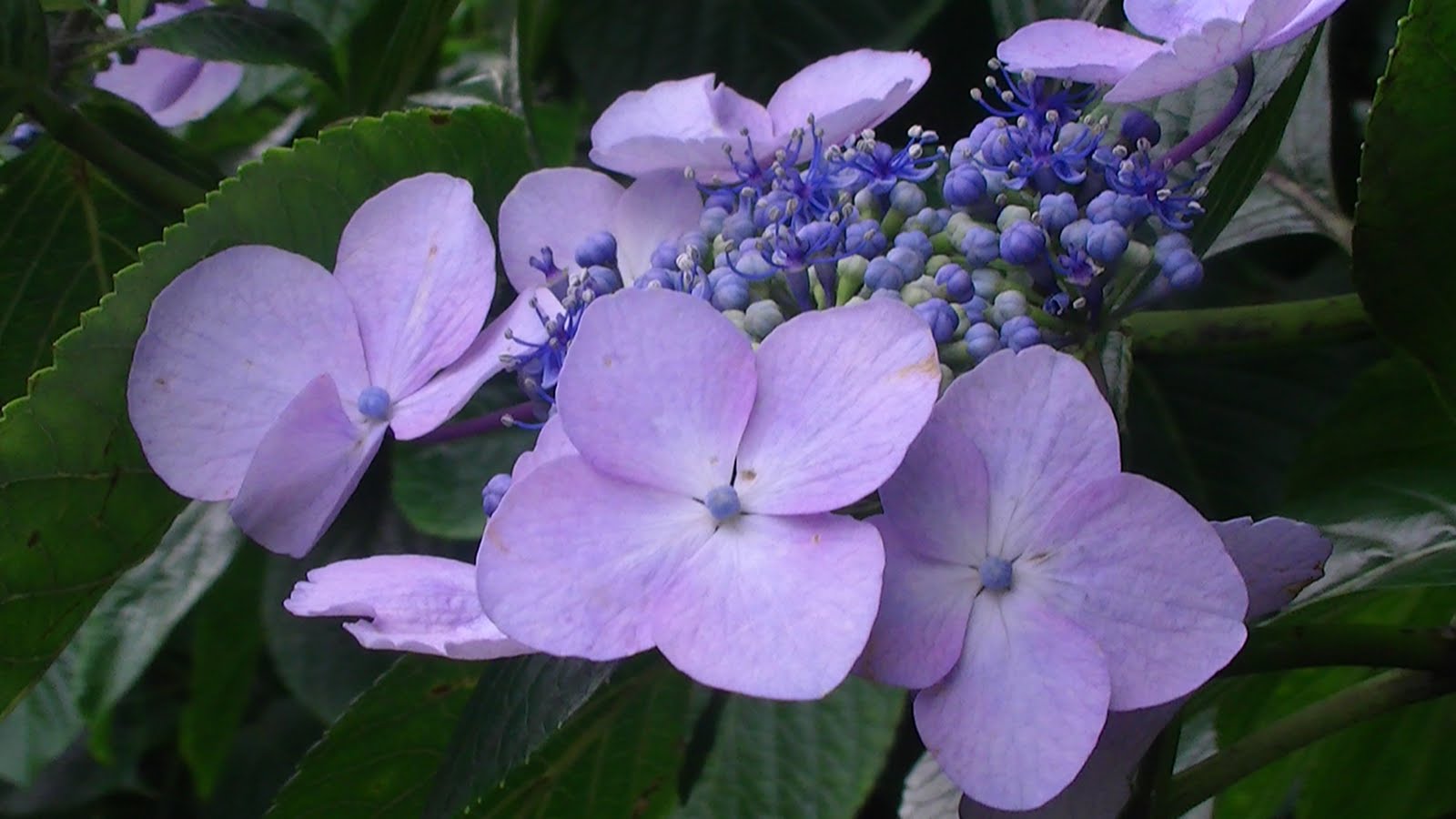
...have I seen hydrangeas so beautifully, naturally blue.  Hydrangea macrophylla.


I took a walk the other day--but not around here.  I went someplace special because the hydrangeas were in full bloom, and if it's ajisai you want to see...


...off to Kamakura you go!  There are hydrangea bushes spilling over every wall, adorning every corner right now.  But one temple in Kamakura is so famous for its ajisai that people know it as well by its nickname-- "Ajisaidera" (Hydrangea Temple)--as by the real name.


Meigetsuin Road
"Mei" means "bright", "Getsu" means "moon", and "in" is "hermitage", also translated as "temple".  It is well over seven hundred years old, and the temple with which it was originally a part over eight hundred years old.

Ja... ikou, yo!


Every alley and cross street is lined with pink, blue, and purple.
Get off at Kita-Kamakura station and hang a right.  There are actually  any number of ancient, lovely temples that date back to the Kamakura period of Japanese history (the shogunate established in 1185 in Kamakura that wrested control away from the emperor for about a century and a half).  But on this particular day I (along with all the other Aunties of a Certain Age) had come to see Hydrangeas, so there was really only one temple to see.

The Ajisai-dera is only 500 meters from the station, so I walked instead of hiring a Jinrikisha (人力車... literally "person-power-vehicle").   It tends to be pricey, which is the other reason I didn't hire one.  Back in the day when I was single and traveling around Kyoto, I did shell out $50 for a ride-- and Ladies, allow me to assure you that fifty bucks is not an unreasonable fee to be pulled around town by a young, lithe, good-looking Japanese guy who runs all day for a living.  They wear tight pants.  The view is worth every bit of that 5000yen...;-))

Gradations of pink to purple on a single bush...
Ahem.

What was I talking about?  Oh.   Flowers.  Right.
It's a good thing I was by myself, as I took a picture of nearly every flower I saw:-))  Actually, all these photos are for my Mommy, who would (like me) stop to look at every. single. flower.  I come by it honest;-))  Happy Birthday, Mom!


Lovely blue Lacecap Hydrangeas (Gaku-ajisai)... and crowds.
In spite of it's having been a weekday, the whole area was quite crowded.  I figured it was the nice weather-- we had two beautiful, sunny days in between a week of clouds and rain.  Which meant that I, along with everybody else, thought it would be a good day to go.  It always seems to be that way here-- no matter what you think of to do, when you get to wherever you were going, you find out that ten thousand other people had the exact same idea...

Blue Lacecap, tending to purplish...
I didn't really mind, though-- I was mostly glad for the break in the weather.  And, as a matter of fact, all the rain in previous weeks meant that the ajisai were gloriously happy about being so well-watered and were busting out everywhere.  The last time I visited this temple, the flowers were rather pale blue-- lovely, but not the intense color I'd remembered from my first time seeing them.


My favorite color...because it occurs naturally:-)

 This year, though, the ajisai were almost pulsatingly blue-- True Hydrangea Blue, not the too-bright royal blue you sometimes see in hothouse hybrids.


Ajisai and Bamboo
The really fascinating thing (to me, anyway) about this species of hydrangea (H. macrophylla), is the way the pH of the soil affects the color of the flowers.  Really!

A bush may be initially pink or blue, but depending on the acidity or alkalinity of the soil and the uptake of aluminum ions from the soil, very often you will see bushes with no two mopheads of flowers the same color.   Here's the relevant bit from Wiki:

"In most species the flowers are white, but in some species (notably H. macrophylla), can be blue, red, pink, light purple, or dark purple. In these species the exact colour often mirrors the pH of the soil; acidic soils produce blue flowers, neutral soils produce very pale cream petals, and alkaline soils results in pink or purple. This is caused by a color change of the flower pigments in the presence of aluminium ions which can be taken up into hyperaccumulating plants.[2][3]"


Don't they give the distinct impression of arteries and veins?
 Are you not diverted?  If you look closely at the stems, you can see how they gradually change color from the main stem to the tiny, branching stems supporting the individual flowers.   The main stem is green (as usual), but changes to pink, to purplish, to blue just beneath the flowers.  I wondered whether this wasn't maybe due to the uptake of aluminum ions as mentioned in the Wiki article....


Pink to Purple... maybe the soil is slightly acidic her
I noticed on the way up the street that the ajisai outside the temple were mostly of the pink variety, which had nearly all morphed to some shade of purple, while all the bushes inside the temple proper were blue (intensely blue this year).  


Not retouched in any way-- this is the actual color I was looking at...
Generally acidic soil, perhaps, causing the basically pink plants to shade to purple, while enhancing the blue of the blue plants?

Ajisai behind the Tea House

 This is getting a bit long, so...


The Tea House


... I'll leave you with a few more images of Hydrangeas at the Ajisai-dera, and continue this post on the weekend with the Other Stuff At The Temple Besides Hydrangeas...
Kamakura Ishi no Sandou


The money shot:  at right, the 800-year-old path of original, weathered Kamakura Stones (鎌倉石の参道... Kamakura Ishi no Sandou).  Of course, ideally, you'd want this shot with just the stone steps flanked by gracefully drooping ajisai and no people, but....


Ajisai and Jinrikisha...


 Hydrangeas, crowds, and Jinrikisha...


...all the bushes looked like this...
Blue ajisai with a touch of purple...

Saturday, February 5, 2011

An Afternoon at the NekoCafe Leon

Leon of the eponymous NekoCafe in Yokohama


At the request of a regular reader here, I have betaken myself and the kids (intrepid reporter that I am) to the Neko Cafe Leon in Yokohama.  Yes, there really is such a thing--a coffee shop with a separate room filled with kitties to play with...for a sizable chunk of change ($6 each for 30 minutes, and an additional $2/10min each after that--and you have to buy at least a drink).

click any photo to enlarge!
 The main attraction of this particular cafe is a Munchkin Cat named Leon (right and above).  He was asleep when we were there, but I could see that his legs really are that short.  I had no idea that there was such a thing as a Wiener Cat...  Leon appears to be a Scottish Fold Munchkin, given his short, folded-back ears.  (The short legs are the result of a naturally occurring mutation similar to the one giving dachshunds and corgis their short legs.)


...this poster of Leon was hilarious.  It says "I turn into a Prairie Dog when I stand up!",  and the white cat is thinking "Now you're the same size as me!"

Leon, in fact, is more than an attraction--the cafe website lists him as Ten Cho--Store Manager, whereas all the other kittehs are Staff...

Here's some video footage of Leon awake and walking around and playing with one of the Abyssinians:


(that's not my video--Leon was asleep while we were there...but it's a cute video, and it gives an idea of how munchkin kittehs move around.)


The NekoCafe was crowded the Saturday we went--we had to leave our name and take a walk while waiting to get in (about a 25 minute wait, though the waiter had said the wait could be up to an hour).  Fortunately Cafe Leon is just around the corner from Ishikawacho Station in the heart of Yokohama--and Yokohama's Chinatown is just on the other side of the station.

One of the Chinatown gates is pictured at right...

Fortunately (or unfortunately), we didn't have to walk around too long before the NekoCafe called me to say the wait would just be a few more minutes and would we please wait just outside the door.  The Chinatown Nikuman would have to be another time...

This was the first time we'd ever gone to a cat cafe, although I'd heard of them.  The first one opened apparently in Taiwan about a decade ago and quickly became a hot tourist attraction, especially among Japanese tourists.  A coffee shop full of cho kawaii kittehs?  It didn't take too long before similar cafes began opening in Japan--Tokyo now boasts almost 40 such cafes, Yokohama has maybe a dozen...and they can be found elsewhere, from Hokkaido to Kyoto to Kyuushuu to Okinawa.  According to Yokohama Walker magazine, February 22 is "Kitty Day"--2/22, the number two in Japanese being "ni" and the word for meow being "ni-yao" or "ni-yan", hence "ni-yan, ni-yan, ni-yan" (meow, meow, meow) Day... get it?

Cat cafes have become very popular on the weekends for couples and friends to go to.  Families with very young children, though, need to check before going, as some cafes have posted age restrictions (such as no children under 6, or that they must be accompanied by and held on the lap of an adult).

Most cafes charge a base rate for an hour (of kitty-time plus cafe-time), usually around Y1000 ($10).


Sometimes a drink is included, sometimes you have to purchase drinks separately.  Weekends seem to be particularly crowded, with waits of up to a hour and correspondingly higher prices.   And, like most places, be prepared to take your shoes off and leave them in the kutsu bako (shoe box) by the genkan.


Some Neko Cafes stay open fairly late (Cafe Leon is open 11am-11pm), maybe catering to business people on their way home from work.  Cat cafes have become a popular way for tired Salary-men and -women to relax after work, especially for those living in apartments where no pets are allowed.


NekoCafe Leon has become so popular that they've opened a separate Rabbit Cafe next door (the coffee shop part is the same, though).  Tell the waiter you want to visit both, and it's noted on your bill.  Customers can then play with the cats and walk through to the other room featuring Bunnies (petting zoos are also very popular here--my kids *love* the petting zoo at Nogeyama Zoo).  We didn't get in there this time-- mata kondo, ne! (next time)

Some Cafes ask customers to sit while staff bring a cat to you, or not to pet sleeping cats.  Cafe Leon is a free-type cafe, where cats roam freely around the room (which is separate from the coffee shop area--probably due to health regulations) and customers may pet or play with any cat they like (asleep or awake).
The main rule (the staff goes over the rules when they bring you the menu) is "Do not do to the cats what they do not like"...  a sensible extension of the Golden Rule.  All the cats at Cafe Leon were friendly and unafraid (most likely chosen for their personalities).  None of the cats seemed nervous of children, either--that's Cici and Teddy there on the left petting one of the "staff".  

At any one time, there are sleeping kitties...

...playing kitties...
...there are plenty of toys on the floor to pick up and play with any kitty who wants to play...
...taking-a-break kitties...
Ceiling Cat is watching you...
 ...kitties hanging from the rafters...
"...Neko wa kotatsu de maruku naru!"
"....Kitty is all curled-up under the kotatsu!"              (a favorite Japanese children's song about snow ends with the dog playing happily outside, and the cat curled up warm under the kotatsu, a low table covered with a blanket and an attached electric heater underneath--clearly the best place in the world for a Kitteh to be;-)
While we were playing, the waiter was fixing our order-- a Leon pancake (dusted with cocoa powder to look like that), and drinks...
...even the bill was appropriately cute, with a Kitty-mark in one corner and a Bunny-mark in the other...
...the kitty I spent most of the time petting--a silky calico kitty...

You wanted to see some video, too--right?  I thought so, so I did my best to walk around with the video camera without stepping on any tails or catching any of the other customers on camera (much)...oh, and no flash photography (so's not to startle the kitties).


 If you're ever in Yokohama--let's play at the Neko Cafe!   Mata asobou, ne!

UPDATE:
   Alert reader Jerry found an additional, not-to-be-missed, video of Leon getting a bath...in the sink where the customers wash their hands!  He also notes that Munchkin Cats come in four sizes--Standart, Super-Short, VW Microbus, and Rug-Hugger.  The smart money is on "Rug-Hugger" for Leon...