This amazing short movie has now passed muster with all three of my kids--big thanks to Bjorn Ostman at Pleiotropy for posting this! I'd not likely have seen it otherwise. I paused the video in places to read (and simplify and explain) to my kids how much life was snuffed out, extinct, gone forever, after the Toba Super Eruption, after the asteroid hit at the end of the Cretaceous, after the Permian-Triassic Great Extinction, after the Ordovician-Silurian Extinction...and then.... oh, just watch already! This 12 minute movie is 16 kinds of cool. If you have children--watch it with them! And if you don't, go run out in the street, grab some kids, and have *them* watch it. Seriously.
Sugoi, desho!
Mata asobou, ne!
Showing posts with label education. Show all posts
Showing posts with label education. Show all posts
Thursday, January 27, 2011


Wednesday, January 12, 2011
School Days--4th Grade Ukiyo-E
 | ||
| Koshi's woodblock print |

"Mama! I have to get one of these for school! Hayaku, kaite! (hurry--fill it out!)" These. One of these...what? Hmmm....another case. He has two other similar cases--second grade was a case with paints, a palette, and brushes (not Prang, either--they use acrylic paints in a tube from kindergarten). Third grade was the calligraphy set--brush pens, ink, weights, inkbox, a roll-up mat. I was ridiculously jealous of my own son for getting to have something that cool for school in the third grade. Iiiiii naaaa....


Thanks, Koshi. I could see that they were tools, but I couldn't get from his explanation ("They're for art!") what exactly they were going to be doing with those.... hmmmm.....what *are* those? Exactly?
No matter--I figured I'd find out eventually. Parent-teacher conferences were coming up in December, and they always have out the things the kids had been making in art class.
And then he brought this home:

Wow! So *that's* what those weird-looking tools were for--making a woodblock print! I don't ever remember getting to make anything that cool in elementary school art class (iiii naaaa....). Or anything that difficult, either, for that matter.

...a closer look
 |
| ...the claws... |
 | |||
| ...the teeth.... |
 |
| ...the dorsal striping... |

All the prints were very detailed, and the kids had clearly worked hard on them.
A brief moment of sickening parental gloating:
(I thought Koshi's was the best one.)
Sorry. All done ;-))

Here's a closer look at those tools.
Yeah--that's exactly what I thought.
Those are *sharp*.
And every kid in the fourth grade has a set like that.
That's a lot of sharp.
They trust kids in Japan. They trust kids, because they know the children have been carefully taught how to be careful.
I noticed it before my kids were born, while teaching English in various language schools. All the jr. high and high school students I taught usually had a cutter knife in their pencil case. They used the cutter knives to trim down handouts so they could be glued into their notebooks, among other uses. I was always fascinated by how carefully every student I saw used their cutter knife. Remove cap and set aside. Push the blade out one or two notches--no more than necessary. Cut. Cut. Cut. Slide blade back. Replace cap. Put away in pencil case. *Then* glue the paper in the notebook (or whatever else). Under no circumstances do I ever recall seeing a cutter knife carelessly left out on a desk, certainly not left open out on a desk.
This was astounding to me until I had kids of my own, and *really* began to watch how the Japanese teach and interact with children. I can think of a number of examples off the top of my head, but I know that as soon as I hit "Publish", I'll think of ten other better ones. So since this post is getting a bit long...
...To Be Continued.... ;-))
 |
| Koshi's favorite print |
Tuesday, November 30, 2010
Furiai Hiroba--Playing With Bamboo at the Fall Festival
Or: What The Fourth Graders Did
As promised, here is the rest of the piece on the Fall Festival held at my kids' school two weeks ago. The first time I posted on this, I wrote about what the first, second, third, fifth, and sixth graders did for the festival. Everybody but the fourth graders, because it would have made the original post too long.
The fourth graders, for the second time (last year's fourth graders were the guinea pigs, apparently), made charcoal out of bamboo, as well as a number of traditional toys. I stopped by school several times to watch the sumi-making process ("sumi" is charcoal or ink)
After they'd gone across the street to cut bamboo (with help, of course, from the teacher and a couple of community members who live near the school), they spent the last hour of the school day one afternoon sawing the long stalks of bamboo shorter, then splitting it so it would burn better.

...Koshi manfully wrestles with the saw:-)) It was harder to saw through than he thought! The group members had to take turns as they got tired...
(Yes--they really trust 10-year-olds with actual sharp saws in Japan. Not yet an overly litigious society...)
....one of the maintenance guys used the iron rings below to split the bamboo length-wise. Then it was cut a little smaller to make pieces of a uniform size for burning to make charcoal. Watch the video below to see how he uses those tools to split the bamboo!

...sledgehammer and iron bamboo-splitting rings (small, medium, and large for various sizes of bamboo).
See? Tap the bamboo down onto the iron ring with the sledgehammer, turn it upside down, and push. Voilà! The bamboo was then dried for a week, and the following Friday put into this contraption:

...he had to seal the edges with clay so the smoke would only go out the actual smokestack...

...and as you can see, this is a completely hand-made affair. Plugged up with a can of DyDo coffee... But it worked just fine--made lovely charcoal (which burned over 24 hours), deep black, perfect to put in the fridge or the shoe box to absorb odors or to filter water in the manner of a Brita.

...Lovely black charcoal, still clearly a piece of bamboo...

... after cutting the charcoal into uniform sizes, the kids bound it with twisty-ties and bagged it for give-away at the festival...
On the day of the festival, I discovered that the kids had made a lot more than just charcoal out of all that bamboo...

Pakah! Pakah! Pakah! Clip-clop, clip-clop! Horses' hooves made from bamboo. You probably had a pair of these when you were a kid, but maybe made out of plastic or cans (stand on top, hold onto the strings, and try to walk). I thought the bamboo made a more realistic, more satisfying, clip-clop...

...the ring toss game--a common game world-wide, but not often made of bamboo...

...low stilts, a nice size for kids to practice walking and balancing on.
....then there were the games the kids had made for parents and siblings to try at the festival, like the bamboo spinner below--as simple a toy as ever there was, consisting only of a flat piece of bamboo and a piece of string threaded through a hole drilled in the center. Markers were out for us "O-Kyaku-san" (Honorable Customers) to decorate if we wished...

Watch Papa below play with the Spinner:
In order to get a baggie of charcoal, we customers had to go around and play with/make all three toys the kids had prepared--the Spinner, the Shooter, and the Take Tombo (Bamboo Dragonfly).

...the Shooter. You stuff wet toilet paper inside this, then use the piece on the left to "shoot" out the toilet paper. Papa was much better at this than I was--he made the pasty toilet paper go at least 10 feet!
My favorite toy, though, is the Take Tombo (Bamboo Dragonfly)--a very traditional children's toy, which in all likelihood originated in China (though it doesn't do to say so to the Japanese ;-)).

...one of the kids is getting ready to make the Bamboo Dragonfly fly! It takes some practice to really make it go--but once you get the hang of it, it's great fun to make it fly far and high.
And most interesting of all (at least to me), was watching an older gentleman whittle one.
Watch:
Did you see how he whittles from the center out, but on opposite sides to balance it so it flies straight? Here's the last bit, where he whittles the handle and puts it in, then demonstrates how to make it fly:
I love those Bamboo Dragonflies--they remind me of the oak seed pods my sis and I called Helicopters and played with as children (another natural toy :-)). But by far my most favorite thing that day was this table full of animals and bugs made of leftover bamboo bits (made by a community group that makes hand crafts like this):

...the Crab...
...the Stag Beetle below...


...the Preying Mantis...

...the Dragonfly...

...and the Kitteh (with the Fox and another Crab visible in the background).
Outside, the fourth graders had also made bows and "arrows" out of bamboo, though I didn't get a good photo of those. I do know, though, that those kids were having a ball that day:-))
Mata asobou, ne!
As promised, here is the rest of the piece on the Fall Festival held at my kids' school two weeks ago. The first time I posted on this, I wrote about what the first, second, third, fifth, and sixth graders did for the festival. Everybody but the fourth graders, because it would have made the original post too long.
The fourth graders, for the second time (last year's fourth graders were the guinea pigs, apparently), made charcoal out of bamboo, as well as a number of traditional toys. I stopped by school several times to watch the sumi-making process ("sumi" is charcoal or ink)
After they'd gone across the street to cut bamboo (with help, of course, from the teacher and a couple of community members who live near the school), they spent the last hour of the school day one afternoon sawing the long stalks of bamboo shorter, then splitting it so it would burn better.

...Koshi manfully wrestles with the saw:-)) It was harder to saw through than he thought! The group members had to take turns as they got tired...
(Yes--they really trust 10-year-olds with actual sharp saws in Japan. Not yet an overly litigious society...)
 |
| the split bamboo |
....one of the maintenance guys used the iron rings below to split the bamboo length-wise. Then it was cut a little smaller to make pieces of a uniform size for burning to make charcoal. Watch the video below to see how he uses those tools to split the bamboo!

...sledgehammer and iron bamboo-splitting rings (small, medium, and large for various sizes of bamboo).
See? Tap the bamboo down onto the iron ring with the sledgehammer, turn it upside down, and push. Voilà! The bamboo was then dried for a week, and the following Friday put into this contraption:
 |
| ...I was so waiting for Bilbo Baggins to walk out of there... |

...he had to seal the edges with clay so the smoke would only go out the actual smokestack...

...and as you can see, this is a completely hand-made affair. Plugged up with a can of DyDo coffee... But it worked just fine--made lovely charcoal (which burned over 24 hours), deep black, perfect to put in the fridge or the shoe box to absorb odors or to filter water in the manner of a Brita.
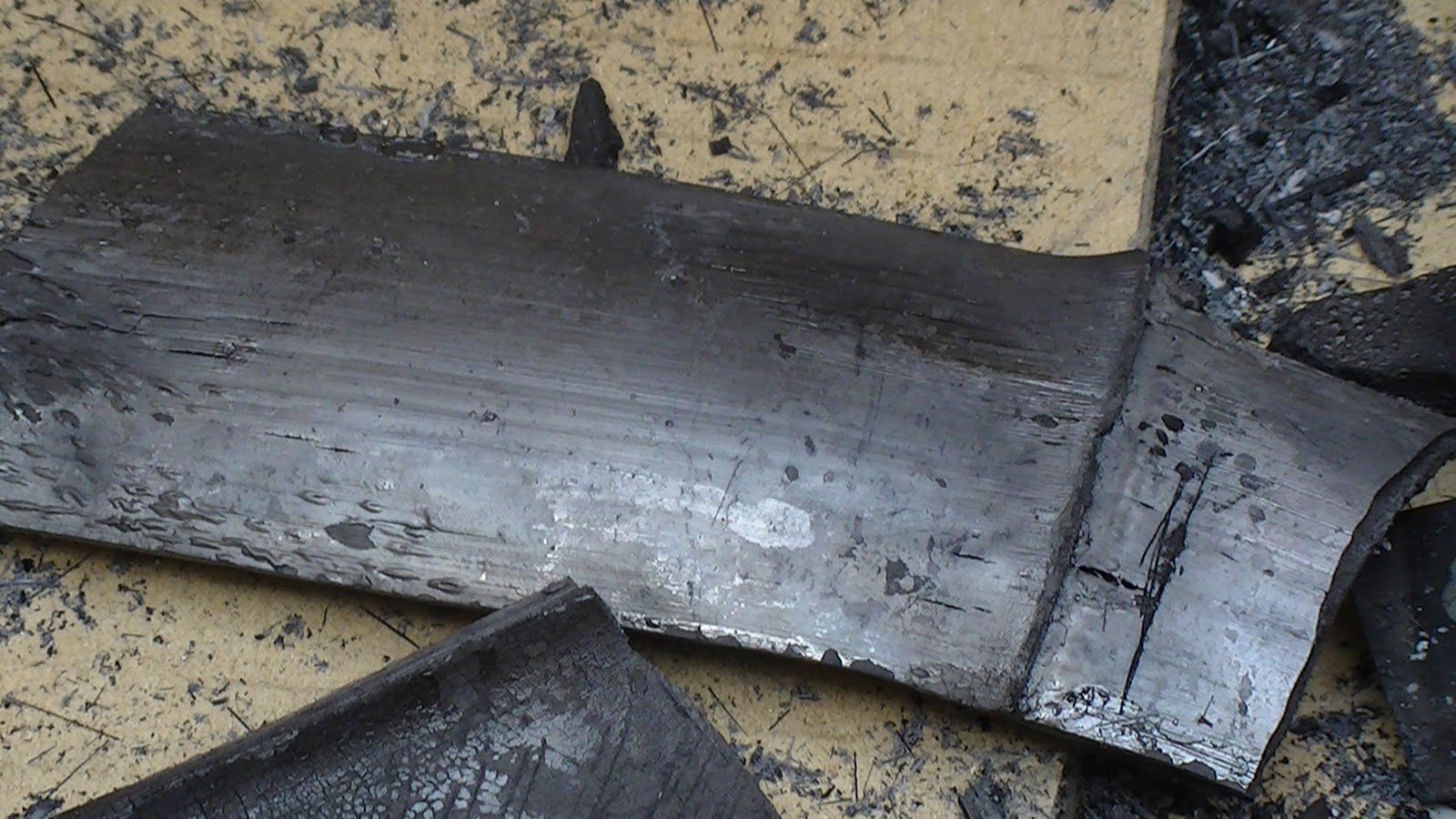
...Lovely black charcoal, still clearly a piece of bamboo...

... after cutting the charcoal into uniform sizes, the kids bound it with twisty-ties and bagged it for give-away at the festival...
On the day of the festival, I discovered that the kids had made a lot more than just charcoal out of all that bamboo...

Pakah! Pakah! Pakah! Clip-clop, clip-clop! Horses' hooves made from bamboo. You probably had a pair of these when you were a kid, but maybe made out of plastic or cans (stand on top, hold onto the strings, and try to walk). I thought the bamboo made a more realistic, more satisfying, clip-clop...

...the ring toss game--a common game world-wide, but not often made of bamboo...

...low stilts, a nice size for kids to practice walking and balancing on.
....then there were the games the kids had made for parents and siblings to try at the festival, like the bamboo spinner below--as simple a toy as ever there was, consisting only of a flat piece of bamboo and a piece of string threaded through a hole drilled in the center. Markers were out for us "O-Kyaku-san" (Honorable Customers) to decorate if we wished...

Watch Papa below play with the Spinner:
In order to get a baggie of charcoal, we customers had to go around and play with/make all three toys the kids had prepared--the Spinner, the Shooter, and the Take Tombo (Bamboo Dragonfly).

...the Shooter. You stuff wet toilet paper inside this, then use the piece on the left to "shoot" out the toilet paper. Papa was much better at this than I was--he made the pasty toilet paper go at least 10 feet!
My favorite toy, though, is the Take Tombo (Bamboo Dragonfly)--a very traditional children's toy, which in all likelihood originated in China (though it doesn't do to say so to the Japanese ;-)).

...one of the kids is getting ready to make the Bamboo Dragonfly fly! It takes some practice to really make it go--but once you get the hang of it, it's great fun to make it fly far and high.
And most interesting of all (at least to me), was watching an older gentleman whittle one.
Watch:
Did you see how he whittles from the center out, but on opposite sides to balance it so it flies straight? Here's the last bit, where he whittles the handle and puts it in, then demonstrates how to make it fly:
I love those Bamboo Dragonflies--they remind me of the oak seed pods my sis and I called Helicopters and played with as children (another natural toy :-)). But by far my most favorite thing that day was this table full of animals and bugs made of leftover bamboo bits (made by a community group that makes hand crafts like this):
 | ||
| rice straw boots, bamboo animals and bugs |

...the Crab...
...the Stag Beetle below...


...the Preying Mantis...

...the Dragonfly...

...and the Kitteh (with the Fox and another Crab visible in the background).
Outside, the fourth graders had also made bows and "arrows" out of bamboo, though I didn't get a good photo of those. I do know, though, that those kids were having a ball that day:-))
Mata asobou, ne!
Tuesday, November 16, 2010
Furiai Hiroba--Fall Festival
Last Saturday was the Fall Festival day at my kids' elementary school--and I actually had time to take some pictures this year since all three of my kiddos are in elementary school and were participating. The stated mission of their school is to allow kids to "live in green and nature". The fall festival is part of that goal--and I, for one, think they do an outstanding job of achieving it.
The first-graders (my daughter's class) gathered thin boughs that were bent into circles to make wreaths.

They also collected acorns, pine cones, berries, and leaves (some of which they spray-painted gold and silver) and brought sequins and ribbons from home
for decoration.
 The room was decorated with the wreaths, shapes, and origami that the kids had made themselves...

...and all the first-graders wore Fall Hats they made the week before, decorated with leaves and acorns and such they'd collected on walks outside (I love it that they don't spend all day sitting in the classroom:)).
At an event like this, the parents, grandparents, siblings and friends are the "patrons" or "customers" who go from room to room making the crafts and playing the games that the children have prepared. Cici's job was to seat people and show them where all the materials were, and let them know that the glue gun was hot:))
In the second grade rooms, "customers" could play various games the children had devised with acorns or make tops or bracelets or Acorn Men (helped by the children). Teddy liked it so much, he brought extra acorns home to make more Acorn Tops out of an acorn and a toothpick (needed a little help with the hammer, though, making the hole:)

Teddy drilling the hole to make Acorn Man
(they still trust kids in Japan to do things carefully, and there wouldn't likely be a lawsuit in the event of an injury...)
The third graders marched all over the school in dragon costumes, banging Taiko drums and dancing.
They were having so much fun, I wanted to join them...:))
The fifth graders were working with rice straw, and anybody who wanted to could go in to learn how to weave a horse or a frog (So. Cute!) from straw. The fifth grade boy I watched making a horse was really good at it--his actions smooth and quick, with few extraneous motions, as though he'd made a bunch of them and was now quite a proficient. It was a pleasure to watch him, and it seemed to me that such opportunities for mastery are unfortunately few and far between in modern schooling. Keep that in mind, next time you're listening to some body's Back to Basics rant...

Called "Wara Zaiku" in Japanese, the kids made posters spelling out the word from rice straw letters (Wa, Ra, Za, I, Ku, left to right).

A woven rice straw horse (Koshi made one of these, too)...

...and the Frog (my favorite!)

...wooden hammers, tree stump workbenches, and pans of water to soften the straw for working. It's nice to take a field trip to watch somebody making things, but so much more fun to learn how your own self!
And the sixth graders? They made lunch! Delicious Tonjiru made with sweet potatoes they'd grown and picked themselves. In fact, Koshi's first Festival four years ago (when he was a first grader) was the first time I'd ever had Tonjiru. It was an unusually cold day, and raining off and on to boot, so that hot soup tasted nothing short of sublime:)) It tasted so good, I asked how to make it--and made it at home the first chance I got!
My bowl of soup--they make theirs with pork, onion, daikon, carrot, sweet potato, gobo, and konyaku. Several more things than I put in when I make it myself, but delicious and filling nonetheless.
We were graciously served by the sixth graders themselves, who brought tea first, then the soup.

...tea and simple, lovely table decorations arranged by the kids from wildflowers they'd picked out around the school...
Quite a deal for fifty cents!
All in all, a lovely morning, enjoyed by parents and children alike:))
Next: What the Fourth Graders Did (or: Fun With Bamboo and How To Make Charcoal)
Mata asobou, ne!
The first-graders (my daughter's class) gathered thin boughs that were bent into circles to make wreaths.

They also collected acorns, pine cones, berries, and leaves (some of which they spray-painted gold and silver) and brought sequins and ribbons from home
for decoration.


...and all the first-graders wore Fall Hats they made the week before, decorated with leaves and acorns and such they'd collected on walks outside (I love it that they don't spend all day sitting in the classroom:)).
 | |
| Mommy's wreath:)) |
At an event like this, the parents, grandparents, siblings and friends are the "patrons" or "customers" who go from room to room making the crafts and playing the games that the children have prepared. Cici's job was to seat people and show them where all the materials were, and let them know that the glue gun was hot:))
In the second grade rooms, "customers" could play various games the children had devised with acorns or make tops or bracelets or Acorn Men (helped by the children). Teddy liked it so much, he brought extra acorns home to make more Acorn Tops out of an acorn and a toothpick (needed a little help with the hammer, though, making the hole:)

Teddy drilling the hole to make Acorn Man
(they still trust kids in Japan to do things carefully, and there wouldn't likely be a lawsuit in the event of an injury...)
 |
| Acorn Man! |
 |
| an acorn bracelet |
 | ||
| Acorn spinner |
They were having so much fun, I wanted to join them...:))
 |
| Third grade Koshi-Dragon! |
The fifth graders were working with rice straw, and anybody who wanted to could go in to learn how to weave a horse or a frog (So. Cute!) from straw. The fifth grade boy I watched making a horse was really good at it--his actions smooth and quick, with few extraneous motions, as though he'd made a bunch of them and was now quite a proficient. It was a pleasure to watch him, and it seemed to me that such opportunities for mastery are unfortunately few and far between in modern schooling. Keep that in mind, next time you're listening to some body's Back to Basics rant...

Called "Wara Zaiku" in Japanese, the kids made posters spelling out the word from rice straw letters (Wa, Ra, Za, I, Ku, left to right).

A woven rice straw horse (Koshi made one of these, too)...

...and the Frog (my favorite!)

...wooden hammers, tree stump workbenches, and pans of water to soften the straw for working. It's nice to take a field trip to watch somebody making things, but so much more fun to learn how your own self!
And the sixth graders? They made lunch! Delicious Tonjiru made with sweet potatoes they'd grown and picked themselves. In fact, Koshi's first Festival four years ago (when he was a first grader) was the first time I'd ever had Tonjiru. It was an unusually cold day, and raining off and on to boot, so that hot soup tasted nothing short of sublime:)) It tasted so good, I asked how to make it--and made it at home the first chance I got!
 |
| Itadakimasu! |
My bowl of soup--they make theirs with pork, onion, daikon, carrot, sweet potato, gobo, and konyaku. Several more things than I put in when I make it myself, but delicious and filling nonetheless.
 |
| Properly dressed in aprons and 'kerchiefs |
We were graciously served by the sixth graders themselves, who brought tea first, then the soup.

...tea and simple, lovely table decorations arranged by the kids from wildflowers they'd picked out around the school...
Quite a deal for fifty cents!
All in all, a lovely morning, enjoyed by parents and children alike:))
Next: What the Fourth Graders Did (or: Fun With Bamboo and How To Make Charcoal)
Mata asobou, ne!
Tuesday, October 12, 2010
Just Say Stats, Mom
My mother cannot, to save her life, pronounce the word "statistics" without tripping or spitting. Most people don't like stats much, even though it feels like we are awash in them sometimes. I used to feel that way myself--that statistics were being used, more often than not, to misinform, to hide the truth. Until I saw Hans Rosling speak on TED (down in links).
The following has nothing whatsoever to do with Japan, but may be loosely correlated with parenting. Anyway, I said down there in my profile that I occasionally write about things that have nothing to do with anything. And this is one of those occasions. Besides--I simply adore this man. He is brilliant, forthright, and his statistics are crystal clear--and utterly amazing. Here is his most recent talk given at TED (he has given three others--watch them all and be amazed):
Enjoy. And learn how to pronounce "statistics".
The following has nothing whatsoever to do with Japan, but may be loosely correlated with parenting. Anyway, I said down there in my profile that I occasionally write about things that have nothing to do with anything. And this is one of those occasions. Besides--I simply adore this man. He is brilliant, forthright, and his statistics are crystal clear--and utterly amazing. Here is his most recent talk given at TED (he has given three others--watch them all and be amazed):
Enjoy. And learn how to pronounce "statistics".
Monday, September 13, 2010
Undokai--an Excercise in Translation

That's Koshi there--in second place. 80m dash.
September and October--Undokai time over here. That's "Track and Field Day". Well, sort of. Translating "Undokai" is kind of like trying to translate German Kuchen and Torte to Cake and Pie. Well, sort of. They don't really match up much. Anybody who's been to Germany and eaten a nice german Kuchen knows that the word may look like "cake", but the thing you ate looked a lot more like pie. Sort of. And the Torte looks like cake. So which word should you use if you want to translate English "cake" into German? And what if you're trying to describe Pie? It doesn't matter which German word you pick, they won't have the right picture in their heads. It's a problem--trust me, I've tried explaining it to Germans before. You go round and round. Which brings me to Undokai.
Undo means excercise, Kai means party or meet or meeting or...a few other things (it's an oft-used word). "excercise party", though, just doesn't quite get the right image across. Every year somebody here asks me if they have Undokai in America, too. Well, sort of. "Track and Field Day", which is what I remember from elementary school, is the event closest in spirit to Japanese Undokai. Sort of. The only thing that matches up from what I remember, is the 50yard dash (our school has 40m for 1st and 2nd grade, 80m for 3rd and 4th, and 100m for 5th and 6th).
But we didn't have the Suzuwari:

gold for the red team...
...and silver for the white team.

They're sort of like pinata, but no candy inside. The kids (in teams) throw beanbags at them till they break open and the streamers come out. The team that gets theirs to come open first wins points (a group point-getting effort). This is traditional--I don't think you could go to an Undokai in Japan and not see this event. The bells (that's what "Suzu" means, "wari" means "break") are iconic--you see them in any depiction of an Undokai. An Undokai with no bells would be Christmas with no tree.


...and the cheerleaders (girls *and* boys, note)
At one point, during the long "encouragement chant" (this stuff just does *not* translate!), the Red Team turns to the White Team and encourages the other team to do their best ("Gambare!"), and vice versa. Do we do this? Somehow, I don't think so. That's my oldest, up there on the right and his best friend with the whistle.
The other thing I've never seen or heard of at Track-and-Field Day, but which is an integral part of the Undokai, is dancing:

awww....aren't they cute:) See--something for everybody! Even the kids who can't run too fast can do well in the dance, or the whole group excercise, or the Suzuwari or the Tama-ire game (throwing beanbag balls into a bucket up on top of a pole--group game). *Everybody* gets to have a good time. Plus--photo ops a-plenty for parents!! (Sorry about all that alliteration...)

That's the first and second graders up above, below is last year's third and fourth graders (my oldest was in third grade last year) dancing to ....can you guess by looking?


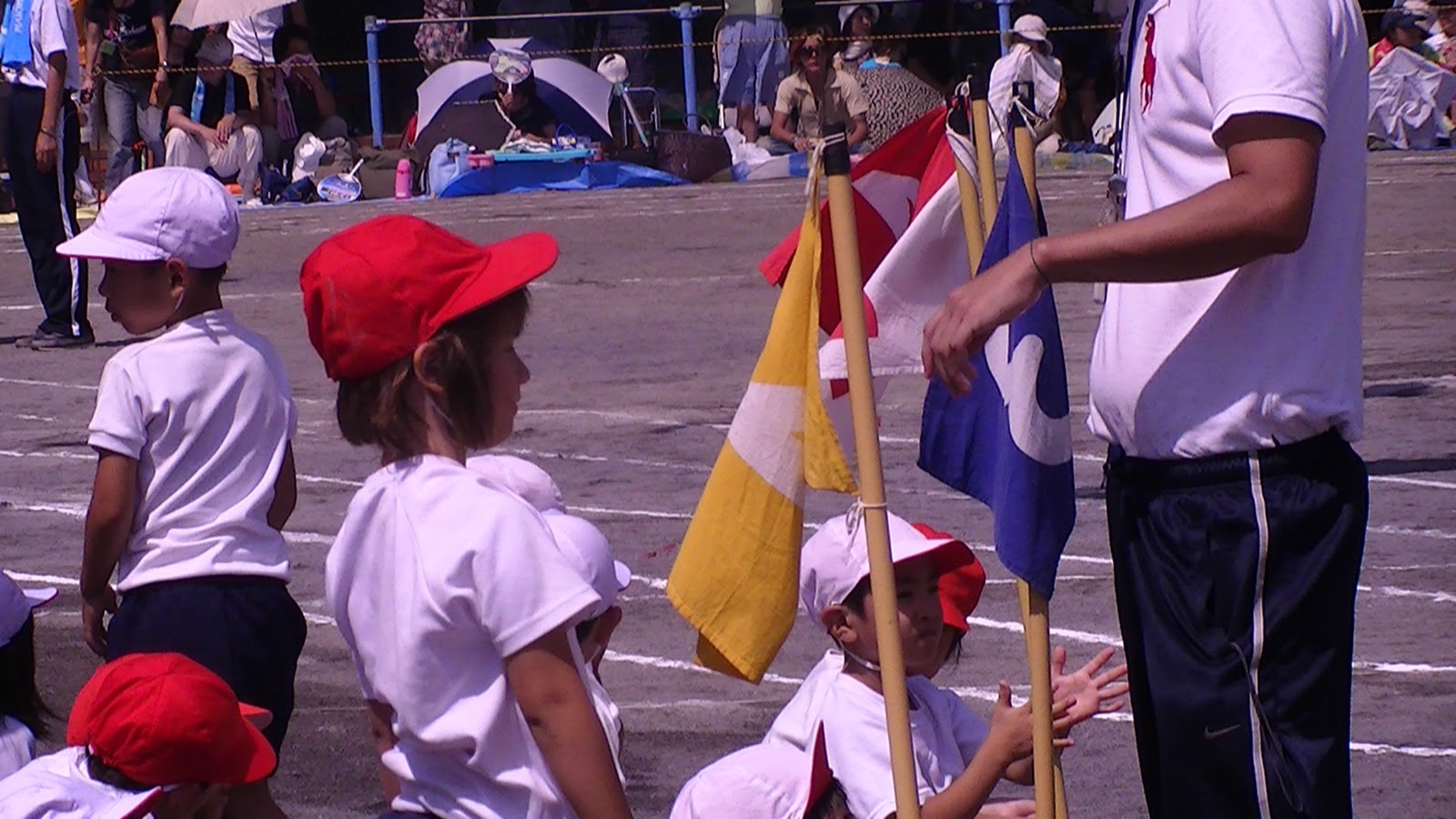
Japanese Undokai is really equal parts competition and cooperation, and it's the cooperation part that's missing from American Track-and-Field Day.
So, now that I've uploaded all these images of Undokai into your brain, you can pull them up the next time I talk about it:)) And not mix it up with Track-and-Field, because they're really only sort of similar.
Mata asobou, ne!
Subscribe to:
Posts (Atom)