Showing posts with label field notes. Show all posts

Saturday, July 9, 2011

Friday Field Notes-- Out and About

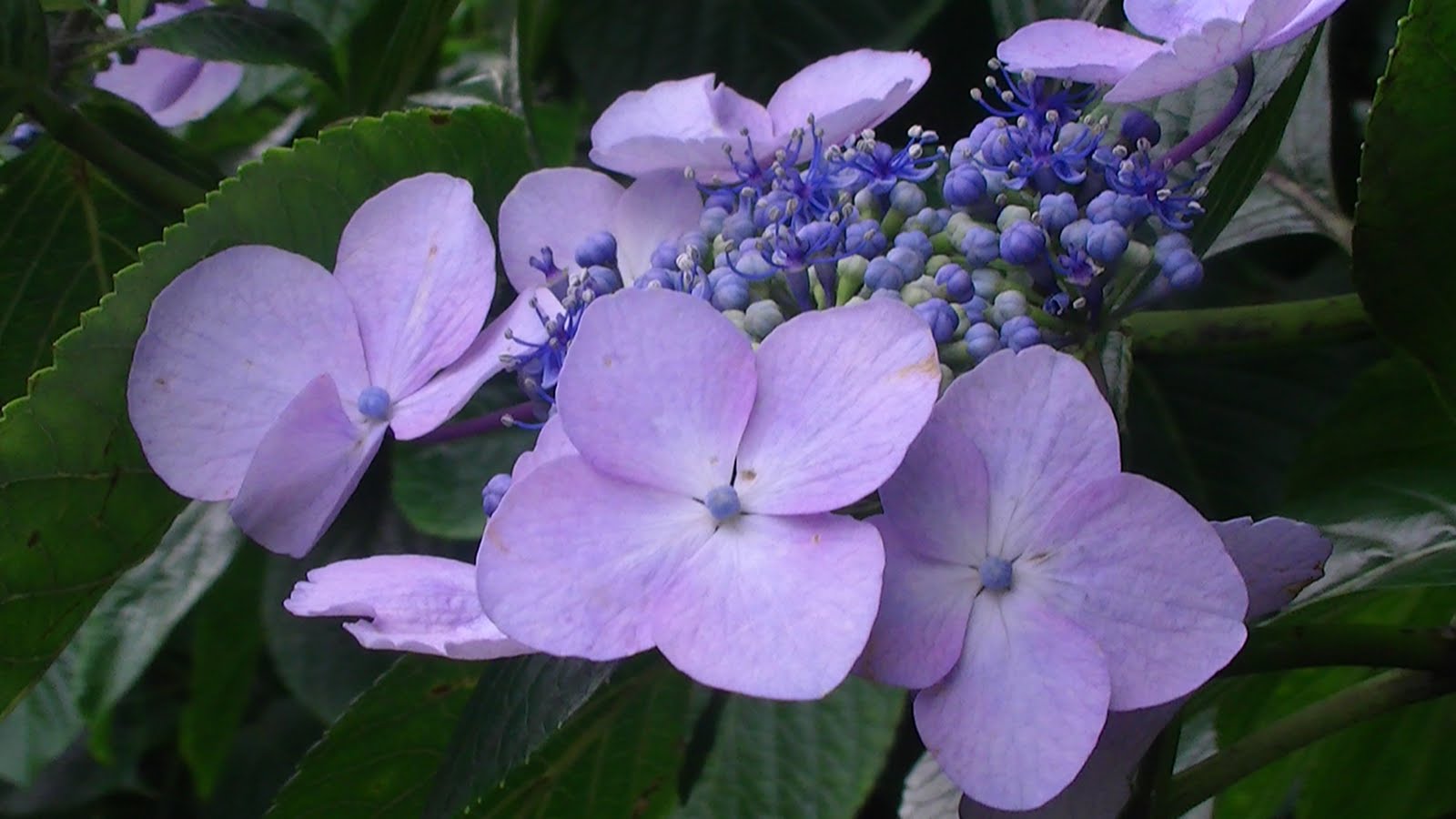
An Ajisai as big as my head!  The biggest one this year--I put my hand on it for perspective:-))


I didn't get a chance to take an actual walk last week or this.  When I sat down to look through photos taken willy-nilly over the last two weeks, I was surprised at how many things I'd stumbled across without particularly looking-- just out and about.  On my way here or there (usually to or from school or Kumon).


Gardening on the Porch
Don't you just love running across something that proves you were right?

The last two summers we've spent at my parents', and so haven't done any gardening on the porch.  But the summer before we had quite a little kitchen garden going out there-- basil, mini-tomatoes, green peppers... and an eggplant.  That's Yochien Cici there, with her eggplant:-))

Thing is, one day I went out to water plants... and the eggplant had sprouted a bizarre branch.  With white (instead of purple) flowers and *thorns*.  Thorns all over the stems and even down the middle rib of the leaves.   It was slightly Jekyll-and-Hyde scary.  The only thing I could figure was that edible eggplant must be grafted onto wild stock, and that this one branch was a throw-back to the wild variety.  Ka na?

Solanum torvum... Wild Eggplant
So on the way home from school last week, I came to a screeching halt (my bike brakes really need oiling or something) when a casual glance left at the so-called weeds coming up under the cherry trees presented this.

Have you seen this before?  I never had--but I knew immediately what it was.  Wild Eggplant-- the exact same thing that sprouted off the main stem of Cici's eggplant, only these were whole plants (I counted 24 of them coming up around the stump of a cherry tree removed last year).

Pretty white flowers-- "Prickly Nightshade" is another name
"Hah!" I shouted exultantly, "Ah Ha!" to no one at all.  It needed saying, though.  I have no idea why it was suddenly coming up all around that stump, but as I sat taking photos, it struck me that the flowers were similar to nightshade.  A trip to Wiki revealed, among a number of common names, "Prickly Nightshade" and "Devil's Fig"-- the first one being a reference to the fact that not only do the flowers *look* like nightshade... they are nightshade.  Eggplant, along with tomatoes and potatoes, is in the nightshade family (Solanaceae), and was therefore thought to be poisonous.

Hey, you cows!  Don't eat my leaves!
Click on those photos up there so you can see the thorns-- this is a plant that *seriously* does not want to be eaten!  I don't think I've ever seen thorns down the center vein of a leaf before...

Those center-vein thorns confirmed, though, that this was indeed what I'd seen growing off the main stem of Cici's eggplant, and a visit to Wiki proved my "wild eggplant" theory right.  Hah!  *crosses arms triumphantly*  Also, eggplants are botanically classified as berries.  Got that?  Quiz next week;-)

Lycaena phlaeas
I've been seeing little Benishijimi everywhere, too, on a variety of flowers. 

On small, white daisies that look like weeds until they are sat upon by a lovely butterfly... (he sat obligingly still while I took his photo, intent on drinking nectar as he was)

The Small Copper

...and I saw him again on bright yellow daisies (or coreopsis), where he turned all the way around getting nectar...


0,1,1,2,3,5,8,13,21.... or?

...on a flower whose whorled center made me think of Fibonacci numbers...

F_n = F_{n-1} + F_{n-2},\!\,


Kanokoga...Amata fortunae

On my way down the river to go home, I noticed a moth I'd never seen before.  A pair of them, in fact, copulating with their bottoms stuck together so that they looked like a single, double-headed creature.

The White-spotted Mot

Then I saw them again.  And again...  I must've seen five pairs of this moth mating, though what exactly was so special about the 28th of June that they must all needs copulate on that date, I'm sure I've no idea.  Everybody was having June weddings?


Ardea cinera


 The following day (Tuesday) was Kumon day, and Cici forgot her homework... necessitating a trip on the bike up to the Kumon classroom to drop it off.

Thank *goodness* I had the camera with me!

Aosagi (the Grey Heron), who doesn't visit our little branch of the river too often, was right there!  In the river behind the bus depot!  I dearly love watching Aosagi-- gawky and elegant, all at the same time--and this time he didn't fly off at my approach (they tend to be rather shyer than the Little Egret, Kosagi).

As I watched, I noticed him open his mouth and shake (or vibrate) the skin beneath his long bill (his wattle, maybe).  I wondered why.  When he did it again, I was ready for it and hit 'record'... and got lucky enough to record him catching and eating a fish!  Have a look:-))


Hagurotombo... Calopteryx atranta
I'll have you know that I kept my wits about me, and actually remembered that I was on my way to Kumon.  I did, in fact, drop off Cici's homework, in spite of all the excitement about the Heron;-)

I was nearly back home when I looked over and saw that the pair of black damselflies I'd seen several times over several days were still in the same place...


Black-toothed Damselfly

...sitting on the same leaves I'd seen them on the day before.

I think they sat on those leaves, over the drainage river, for a week.  They occasionally changed spots to a neighboring leaf, but otherwise remained in roughly the same place.  Very mysterious behavior, I thought, for which I still have no explanation....


Yabukarashi...Cayratia japonica
I found the early beginnings of Yabukarashi vines here and there--the vine that butterflies seem to love.  And ants, as I discovered taking this close-up of the flowers.  Click on that so you can see the liquid clinging to it that the ant was drinking.  I got a better photo of the tiny flowers this time--good enough to see that they're not all pink, but pink and orange, like tiny cups of sherbet...

Nothing to see here... or is there?

Of course, I've saved the best for last:-))

I was just in a hurry to get home before the predicted drizzle started in-- I had laundry out drying that needed to come in.

Hopped on the bike at school... pedaled past the temple... took the left fork at the machinist's shop behind the bus depot... and looked at the fence.

Do you see it?  No?  Have a closer look:

Shima-Hebi
I did not fall off my bike.

He sat there-- I would say still as a stone, but it would have to be a very flexible stone to be woven in and out of those small spaces in the fence like that.

I walked right up to him and took several pictures, and he never moved.  I took the camera out of the bag, thinking to catch him and take him home to Koshi so we could look him up online.  As soon as my fingers grasped the longest part of his midsection protruding from the fence, though, he instantly slithered quickly forward.  I let go, afraid that if I held him tightly, he would struggle and scratch or hurt himself in the metal fence.  He wove his way further down the fence, like a shuttlecock in and out of the weft... then disappeared into the vegetation behind the fence. 

Stop and stare whenever you're out and about-- 'cause you just never know... ;-)

Japanese Four-Lined Snake... Elaphe quadrivirgata

Thursday, July 7, 2011

Never In All My Days...

...have I seen hydrangeas so beautifully, naturally blue.  Hydrangea macrophylla.


I took a walk the other day--but not around here.  I went someplace special because the hydrangeas were in full bloom, and if it's ajisai you want to see...


...off to Kamakura you go!  There are hydrangea bushes spilling over every wall, adorning every corner right now.  But one temple in Kamakura is so famous for its ajisai that people know it as well by its nickname-- "Ajisaidera" (Hydrangea Temple)--as by the real name.


Meigetsuin Road
"Mei" means "bright", "Getsu" means "moon", and "in" is "hermitage", also translated as "temple".  It is well over seven hundred years old, and the temple with which it was originally a part over eight hundred years old.

Ja... ikou, yo!


Every alley and cross street is lined with pink, blue, and purple.
Get off at Kita-Kamakura station and hang a right.  There are actually  any number of ancient, lovely temples that date back to the Kamakura period of Japanese history (the shogunate established in 1185 in Kamakura that wrested control away from the emperor for about a century and a half).  But on this particular day I (along with all the other Aunties of a Certain Age) had come to see Hydrangeas, so there was really only one temple to see.

The Ajisai-dera is only 500 meters from the station, so I walked instead of hiring a Jinrikisha (人力車... literally "person-power-vehicle").   It tends to be pricey, which is the other reason I didn't hire one.  Back in the day when I was single and traveling around Kyoto, I did shell out $50 for a ride-- and Ladies, allow me to assure you that fifty bucks is not an unreasonable fee to be pulled around town by a young, lithe, good-looking Japanese guy who runs all day for a living.  They wear tight pants.  The view is worth every bit of that 5000yen...;-))

Gradations of pink to purple on a single bush...
Ahem.

What was I talking about?  Oh.   Flowers.  Right.
It's a good thing I was by myself, as I took a picture of nearly every flower I saw:-))  Actually, all these photos are for my Mommy, who would (like me) stop to look at every. single. flower.  I come by it honest;-))  Happy Birthday, Mom!


Lovely blue Lacecap Hydrangeas (Gaku-ajisai)... and crowds.
In spite of it's having been a weekday, the whole area was quite crowded.  I figured it was the nice weather-- we had two beautiful, sunny days in between a week of clouds and rain.  Which meant that I, along with everybody else, thought it would be a good day to go.  It always seems to be that way here-- no matter what you think of to do, when you get to wherever you were going, you find out that ten thousand other people had the exact same idea...

Blue Lacecap, tending to purplish...
I didn't really mind, though-- I was mostly glad for the break in the weather.  And, as a matter of fact, all the rain in previous weeks meant that the ajisai were gloriously happy about being so well-watered and were busting out everywhere.  The last time I visited this temple, the flowers were rather pale blue-- lovely, but not the intense color I'd remembered from my first time seeing them.


My favorite color...because it occurs naturally:-)

 This year, though, the ajisai were almost pulsatingly blue-- True Hydrangea Blue, not the too-bright royal blue you sometimes see in hothouse hybrids.


Ajisai and Bamboo
The really fascinating thing (to me, anyway) about this species of hydrangea (H. macrophylla), is the way the pH of the soil affects the color of the flowers.  Really!

A bush may be initially pink or blue, but depending on the acidity or alkalinity of the soil and the uptake of aluminum ions from the soil, very often you will see bushes with no two mopheads of flowers the same color.   Here's the relevant bit from Wiki:

"In most species the flowers are white, but in some species (notably H. macrophylla), can be blue, red, pink, light purple, or dark purple. In these species the exact colour often mirrors the pH of the soil; acidic soils produce blue flowers, neutral soils produce very pale cream petals, and alkaline soils results in pink or purple. This is caused by a color change of the flower pigments in the presence of aluminium ions which can be taken up into hyperaccumulating plants.[2][3]"


Don't they give the distinct impression of arteries and veins?
 Are you not diverted?  If you look closely at the stems, you can see how they gradually change color from the main stem to the tiny, branching stems supporting the individual flowers.   The main stem is green (as usual), but changes to pink, to purplish, to blue just beneath the flowers.  I wondered whether this wasn't maybe due to the uptake of aluminum ions as mentioned in the Wiki article....


Pink to Purple... maybe the soil is slightly acidic her
I noticed on the way up the street that the ajisai outside the temple were mostly of the pink variety, which had nearly all morphed to some shade of purple, while all the bushes inside the temple proper were blue (intensely blue this year).  


Not retouched in any way-- this is the actual color I was looking at...
Generally acidic soil, perhaps, causing the basically pink plants to shade to purple, while enhancing the blue of the blue plants?

Ajisai behind the Tea House

 This is getting a bit long, so...


The Tea House


... I'll leave you with a few more images of Hydrangeas at the Ajisai-dera, and continue this post on the weekend with the Other Stuff At The Temple Besides Hydrangeas...
Kamakura Ishi no Sandou


The money shot:  at right, the 800-year-old path of original, weathered Kamakura Stones (鎌倉石の参道... Kamakura Ishi no Sandou).  Of course, ideally, you'd want this shot with just the stone steps flanked by gracefully drooping ajisai and no people, but....


Ajisai and Jinrikisha...


 Hydrangeas, crowds, and Jinrikisha...


...all the bushes looked like this...
Blue ajisai with a touch of purple...

Saturday, June 4, 2011

Friday Field notes-- Beetles and Bugs

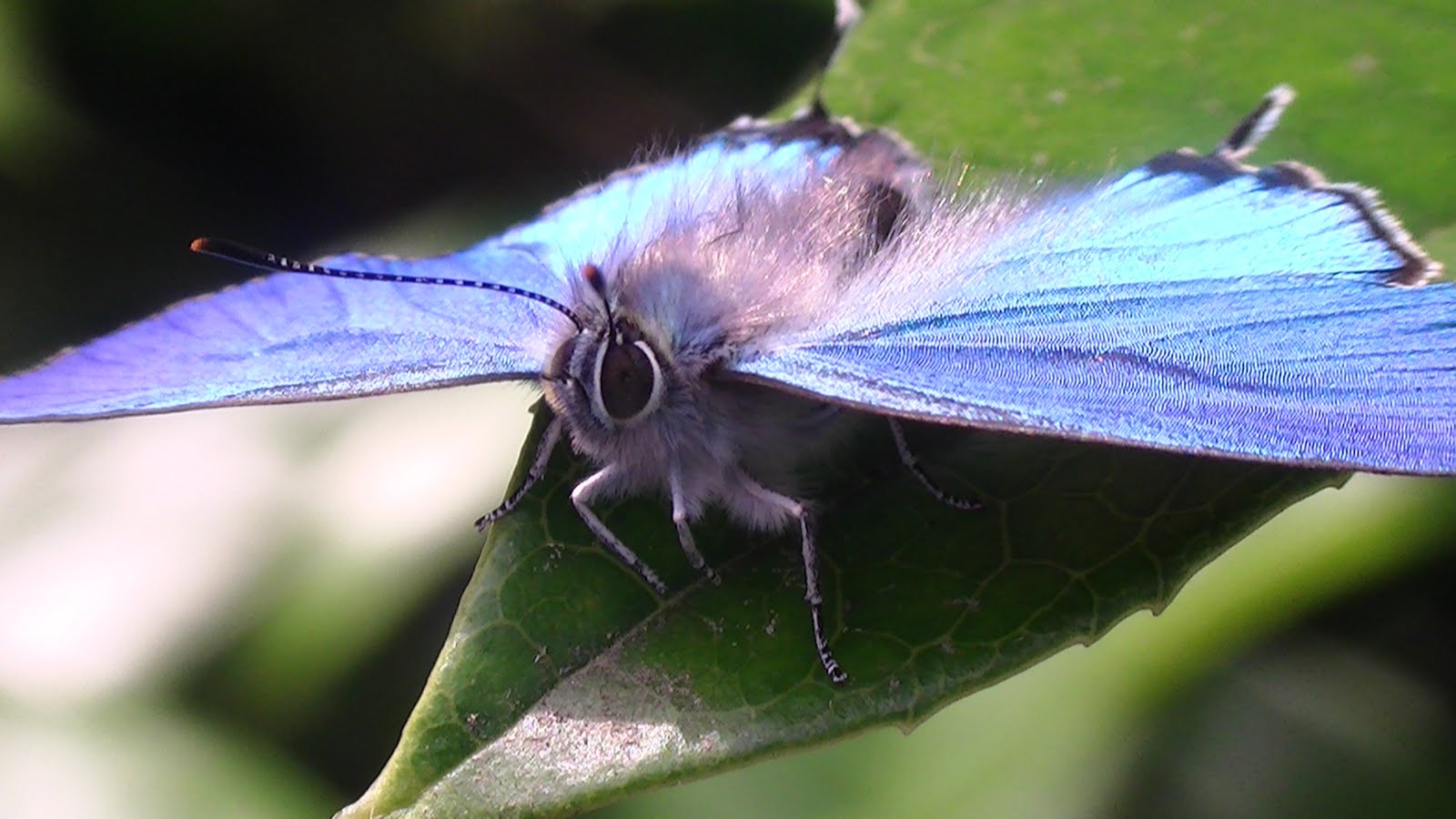
オオミドリシジミ... Favonius orientalis (the Oriental Hairstreak)


Walking the kids to school this morning I saw the most gorgeous blue butterfly, and couldn't stop to take a picture of it because I had my hands full of crawdads.


Koshi's Zarigani (crawdads)
Koshi caught a boxful of crawdads yesterday and left the whole mess--box of crawdads, bowls of water with more crawdads, nets, dried fish bait--on the stairs while he and his friend were playing.  He attempted to mollify me by assuring me that all the crawdads were to be taken to school and looked after there.  And could I please go to the store and buy a bag of heavy rocks to layer on the bottom of the box.

Hmph.  Clean it up *before* Papa comes home.

click to embiggen

Which is how I ended up with my hands full of crawdads this morning when I noticed something gleaming brilliantly blue over in the bushes.


 I walked over to have a look (box of crawdads occupying both hands, camera hanging uselessly from my shoulder)...  wow!

...or view on Flickr (link in sidebar)
I had no clue who it was, and couldn't do anything about it with, as I say, my hands full of crawdads.  There was nothing to do but go on up to school, hand over the crawdads, and hope to goodness my lovely butterfly would still be in the area when I got back.

In luck!  There he was, just a sunnin' on a leaf...


The ID shot-- orange spots are *not* connected

...I even got a couple of good shots of the back side of his wings (ventral side?) to ID him.  Oooh-- an Oriental Hairstreak!  This sort of thing just makes me wiggle.  And squeal.


It's not even what I was looking for this morning.

I was  looking for Beetles and Bugs this morning-- representatives of Coleoptera and Hemiptera (the 'True Bugs') respectively.  Not that I have any confidence whatsoever in my ability to tell the two apart.  Being able to more or less tell Beetles from Bugs was the task I'd set myself earlier in the week after posting photos to Flickr.  Misidentified photos--Beetles labeled Bugs, and vice versa.  D'oh!  
On the next leaf over-- the first snail of the Rainy season in a pearly shell, smaller than my pinky fingernail


So, after getting several nice photos of the lovely Hairstreak who was kind enough to wait 'til I came back (sans crawdads), I determined to walk a bit and see what I could see.  In the way of Beetles.  And Bugs.  I'd done some research trying to figure out just what the difference is (well, to an entomologist, anyway, if not to the average layperson like me.  Don't ask why this is suddenly so important--suffice to say that I've got a Beetle in my Bonnet.  Or possibly a Bug.).

I wonder why ferns have a non-skid surface on the underside?
Now I needed some friendly critters who would be willing to sit still long enough for me to take a picture or two of them and make a guess as to which camp they belonged in--Beetle or Bug.

Naturally, I found everything but those for the first hour I was out.


Cephalopod?  No--new fern;-)


...beautiful fiddleheads, uncurling toward me, looking more like denizens of the seas than of the forest...

No Bugs.

I can't see with this piece of wood in the way!
Ooh--some eggs on a branch!  I wonder whose?  I looked closer, trying to get a better look at the eggs around an annoying piece of wood stuck to the branch.


オオエグリシャチホコ...Pterostoma sinicum
...piece of wood with legs.  That's no woodchip--that's a moth.  Probably the moth who laid the eggs, or?
Perfect mimicry-- I was completely taken in, until my eyes were only a few inches away.  She never moved, even when I gently brushed a fingertip against her wing.  Just astonishing--I'd have gone on believing her a woodchip had I not noticed her legs.  Not a Beetle, though, so off we go.


Philudoria albomaculata
Three steps or so on, I noticed something yellow down among the leaves and stooped to check.  Mercy, what an enormous catepillar!  Surely one of the fattest I've ever seen--all over hairy, too.    He's going to be 'Takekareha', according to Koshi's insect encyclopedia.  I notice the 'Kare' (curry) in the middle of the name, and wonder whether it's a reference to the color of the catepillar-- as curry-colored a beastie as ever there was.  But not a Beetle.  Pushing on...


Hoverfly on Bachelor's Button (Episyrphus balteatus)
 The reason, in fact, that I've got Bugs and Beetles on the brain this week is a photo I posted in last week's Field Notes--  an unidentified photo of a bright black and mango yellow critter hanging upside down from a flower bud.

Right next to the Bachelor Buttons.
He was still there this morning, he and his fellows,  crawling over the same flowers.


Aulacophora nigripennis.... Order: Coleoptera
I finally got around the other day to looking him up.  Aha!  Kurourihamushi.  I updated the blog post and the Flickr photo with the common name and the taxonomic binomial.  I also, in a moment of rashness, added "Order: Hemiptera" to this photo.  Rong!  And there's a way to tell just by looking at this photo, which order he really belongs in....


アカスジキンカメムシ... The Clown Stinkbug (Poecilocoris lewisi).  The Most Beautiful Bug I've Ever Seen.

This is, without a doubt, the Most Beautiful Insect I've Ever Seen.  I discovered him sitting right in front of my nose, just three leaves over from a small blue-black beetle (bug?) I was trying to photograph.  Didn't come out.  I started to step back in annoyance when something hot pink and glinting gold caught my eye.  Right in front of my eyes, in fact.  He sat quite still while I took his picture... then allowed me to scoop him into my camera bag to take him home so I could show the kids when they got home:-)  He wasn't hard to find in the book, though finding his English handle took some time.  I should have figured it out myself when I put my face close to the bugbox to get a better look at him.  Stinky!  Heavens to Betsy, what a smell!  I wanted to post this photo in a Flickr group I'd found for photos of Coleoptera called "An Inordinate Fondness for Beetles" (so named after biologist J.B.S. Haldane's wry response to someone asking what the Creation tells us about the Creator, to which he replied "If there is a God, He has an inordinate fondness for beetles.")

Oxycetonia jucunda... not a bug!  Beetle!
Before posting my fantastic beetle (so I thought), I decided to double-check.  It would be slightly embarrassing to have my photo bounced out of the group because it wasn't actually a beetle.

Good thing I checked Encyclopedia of Life.  That thar varmint's a Bug.  Hemiptera.  A True Bug, an entomologist would say.  A pro photographer at the Beetle group had posted a very helpful series of photos with an explanation to help amateurs ID their photos.  First:  a beetle's wing covers meet in a straight line down the back (see daisy photo above).  The critter on the daisy is Order: Coleoptera.  Beetle.  Not Bug-- wing covers meet straight down the middle.

Minamitogehemikamemushi (Paradasynus spinosus)
This gentleman, pictured right, who paid a visit to my north window is a Bug.  See how the wing covers form an X shape on his back?  That just screams "Bug!" to a biologist.  In this photo, though, there's one other even easier way to tell.  Click on it so you can see it large, and count his antennae sections.  Did you count 4 or 5?  Bug.  Beetles have 10 or 11 sections (looks like lots of little joints all down the antennae).  Go back up to Upside Down Guy (black and yellow above).  Look at his antennae.  *Way* more than 4 or 5.  Coleoptera, without a doubt.

Bug on left: same as above photo; right: Akasahigame (Cydnocoris russatus)
Can you guess the red insect at left?  If you guessed Bug (Hemiptera), you'd be right.  Wing covers make an X on his back, antennae in 4 or 5 sections.  True Bugs have sucking mouthparts that distinguish them, but which are not always visible nor easy to find.  The Hemiptera include cicadas, aphids, planthoppers, leafhoppers, shieldbugs, stinkbugs, and others.  And my Exquisitely Beautiful Insect up there?  Look again, and check his antennae:

The Most Beautiful Bug I've Ever Seen.... Order: Hemiptera (antennae in 4 sections)