Thanks to KK over at BABS, I now have Miyazaki on the brain. In the US I think most everybody knows "Spirited Away", and some who really loved that film (like KK and my sis) went out and watched all the Studio Ghibli movies they could get a hold of. But before starting down the slippery slope of Miyazaki geekiness, and telling you every little thing I love about Tonari no Totoro, I'd like to put out a question first.
As it happens, I have never watched any of these films in English. I watch them with my kids, so of course we watch them in Japanese. What I'm wondering about, for those who have only watched the English version, or who watched the subtitled version without knowing Japanese, is this: Did you get how Chihiro's name was changed from Chihiro to Sen? Watch the trailer below, because it briefly shows that scene. Then, if you don't mind, please let me know in the comments how you understood it. Thanks! First time commenters welcome! I'm just curious whether Non-Japanese-speaking audiences understood that scene the way Japanese-speaking audiences did. Thanks to all who indulge my curiosity and take a moment to reply!
After I get some comments, I'll update this post and tell you how that scene is understood in Japanese:))
UPDATE!
First--thanks to all who responded:)) And congratulations to Falen--you pretty much got how Chihiro came to be called Sen. Yes, it's to do with the Kanji of her name--and Ezmirelda, even though you "only" know 20 Kanji, you probably know this one: 千 (hope everybody's PCs can read that). Yubaba takes only 3 of the 4 Kanji that make up Chihiro's name--the two of her last name and the second of her first name. She leaves on the page the first Kanji of her first name, the "chi" part. Her names translates (loosely) as "a thousand murmurs". The Kanji I put up there is read "chi" in the Japanese reading and in names. On it's own, it's read as "Sen", which is the Chinese reading, and it's the number 1000. Yubaba has simply switched from the Japanese to the Chinese reading of the character, so the new name "Sen" isn't arbitrary. It's a great choice of name for her character, though, since that Kanji is a number--it's as though she's been given a number rather than a name, and it increases the sense that she is being imprisoned. I also get the feeling (although I've never heard Miyazaki say this, so maybe it's just my idea) that it's an oblique reference to the Thousand and One Arabian Nights, since Chihiro offers herself to Yubaba as a worker in order to *not* be turned into a pig and to give herself time to figure out how to escape the twilight world. And just as I wrote the word "twilight", I realize that Miyazaki has depicted the Goetterdaemerung--the Twilight of the Gods.
Thanks again to those who responded ! And I'm pleased as punch to know that most of my commenters are as big a Miyazaki fan as I am:))
And to anybody reading this who has never seen Spirited Away ("Sen to Chihiro no Kamikakushi"), run don't walk! Put it in the Netflix cue, get it from Blockbuster, nick it from your neighbor, but don't go another minute without seeing this film. They had the presence of mind in Berlin to award this film Best Picture (not Best Animated Picture, note).
Did you see that? Did you see how he drew the children scrubbing the wooden floors, running up and down with rags? He didn't make that up--that's exactly how wooden flooring is cleaned. Japanese elementary kids do it like that every day at school--my kids, too. That's how he brings his wild flights of fancy to life--they are grounded in concrete reality. Sorry--geek rant over. Enjoy!:))
Tuesday, October 19, 2010


Monday, October 18, 2010
Monday Manglish--The Notebook Edition
Today's Manglish was all found on notebooks. All of which I purchased for the sole purpose of owning such delightfully silly prose, and having it in convenient notebook form to carry around and snicker over at will. One must have something thrilling to read on the train, after all:))

"Time to look at beautiful jewel,
it is a terrible, luxurious time."
I'd love to know why somebody thought the word "terrible"
belongs in there....

"a look of fearless determination
DAUNTLESS"
Those phrases are, of course, perfectly sensible. Just not necessarily
on the cover of a very small ring notebook. I chose to use this one to
keep my food diary in, assuming that if I intend to take off the pounds
I put on at my parent's over the summer, I would need to be...
DAUNTLESS!

And finally, simple and sweet, "This is a durable and simple cover notebook. This notebook is usable in various uses." Usable in various uses... and yet you don't dare give them a Thesaurus:))

"Time to look at beautiful jewel,
it is a terrible, luxurious time."
I'd love to know why somebody thought the word "terrible"
belongs in there....

"a look of fearless determination
DAUNTLESS"
Those phrases are, of course, perfectly sensible. Just not necessarily
on the cover of a very small ring notebook. I chose to use this one to
keep my food diary in, assuming that if I intend to take off the pounds
I put on at my parent's over the summer, I would need to be...
DAUNTLESS!

And finally, simple and sweet, "This is a durable and simple cover notebook. This notebook is usable in various uses." Usable in various uses... and yet you don't dare give them a Thesaurus:))
Friday, October 15, 2010
Friday Field Notes--out of the Cracks
I admit to being fascinated by plants of any kind that grow up out of cracks in concrete or asphalt. Years ago my mom pointed out a funny photo in the Indy Star to my dad--of a corn plant (already 5 feet tall or so), with an ear of corn no less, growing up out of a crack in the concrete in the median of US 31. The photo was captioned "Purdue Ag Department Experiment". We all thought it was hilarious--and it had the effect of making me notice for ever after *anything* growing up out of a crack.
Moss is lovely:
 ...growing out of the crack between the street and a damp stone wall. I dearly love moss--I nearly always touch it if I find some.

...it's even nicer if you get down on your hands and knees and have a closer look (this must be why my pants always have a hole in the knee). See? It looks like a succulent, doesn't it? Click on that photo, won't you, so you can see it properly. Up close you wonder, is that how moss flowers? Or is something else growing up from beneath the moss?
Then there are those small, flat-growing plants that everybody just walks right over without noticing:

 Take a closer look--click on that photo, if need be. See those wee flowers? Up close, it's rather attractive, no? It's Kohakobe, or stellaria media. Nearly invisible stars of flowers that we walk over every day. It's growth habit ensures the plant won't be fatally damaged, although I don't think it *enjoys* being trod upon. There's also a close relative of this one called, appropriately enough, stellaria neglecta.
 ...*exactly*. What the heck is that?! Look at that broken asphalt! Look at that enormous, fat stem bursting from a man-made ground! Oh--right, you want to know what it is.

 ....besides, it was coming up in several other places as well. This is not the kind of sidewalk-crack-plant you walk over without noticing. I saw this stuff coming up in this place last year and just assumed it was a fluke, or maybe a joke. Nope. Came right back up again this year--same places by the Circle K parking lot and along the sidewalk and wall up to the Kumon classroom.
Makes a nice visual metaphor for perseverance, don't you think?
Here's a closer look at O-Jizosama (below):


Gambare, Yabukarashi!

Moss is lovely:
 ...growing out of the crack between the street and a damp stone wall. I dearly love moss--I nearly always touch it if I find some.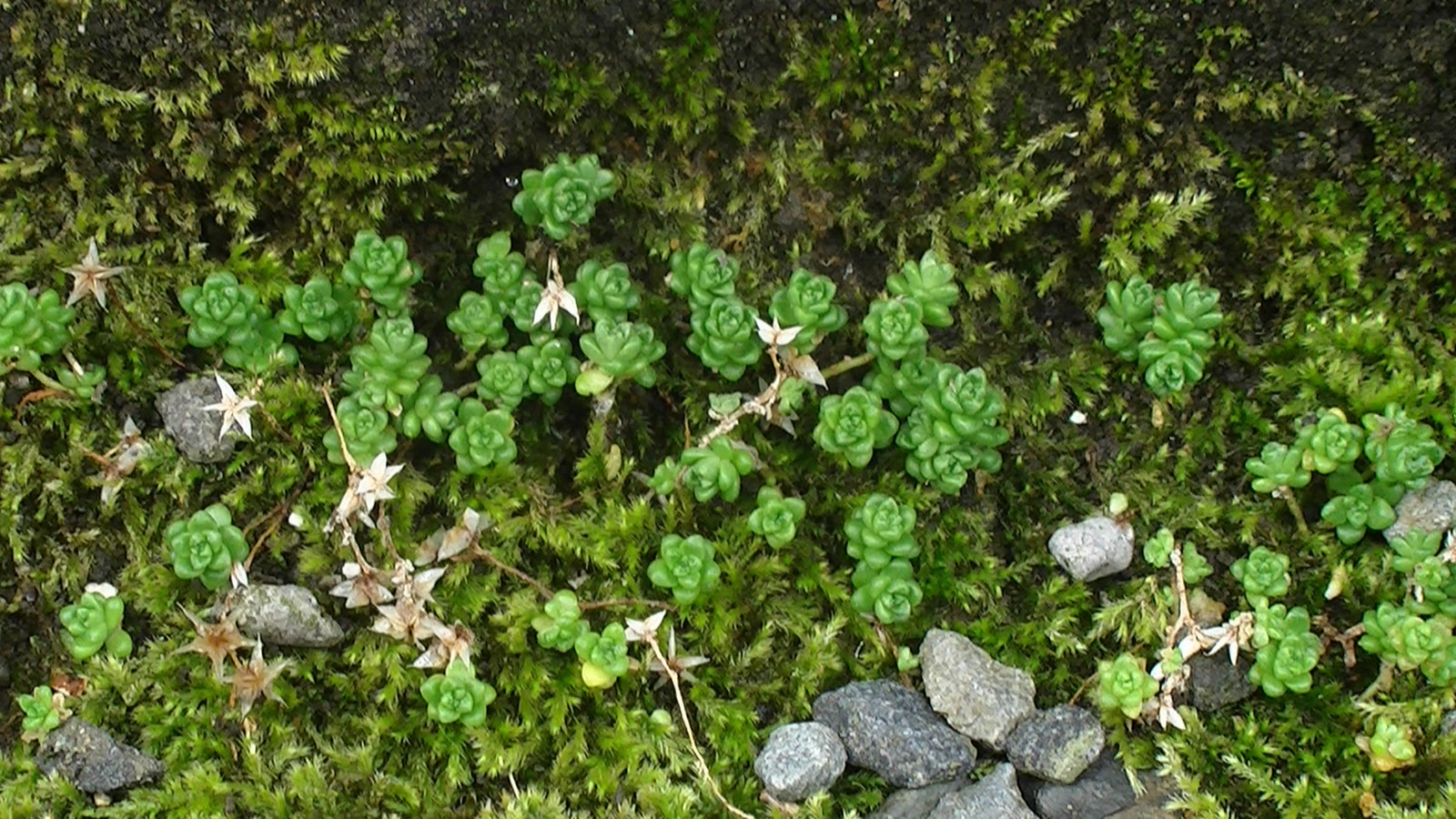
...it's even nicer if you get down on your hands and knees and have a closer look (this must be why my pants always have a hole in the knee). See? It looks like a succulent, doesn't it? Click on that photo, won't you, so you can see it properly. Up close you wonder, is that how moss flowers? Or is something else growing up from beneath the moss?
Then there are those small, flat-growing plants that everybody just walks right over without noticing:

...coming right up between the asphalt of the sidewalk and the concrete block top of the river wall. I honestly admire plants like this--they just exude that "never-say-die" spirit, don't they:)) This is the sort of plant that gardeners *hate* pulling from out between their bricked walkways. It has strong roots--it doesn't pull up easily.
 Take a closer look--click on that photo, if need be. See those wee flowers? Up close, it's rather attractive, no? It's Kohakobe, or stellaria media. Nearly invisible stars of flowers that we walk over every day. It's growth habit ensures the plant won't be fatally damaged, although I don't think it *enjoys* being trod upon. There's also a close relative of this one called, appropriately enough, stellaria neglecta.
But, hands down, my best find recently was this gigantic thing coming up between a wall and the sidewalk next to the Circle K across from the bus center:
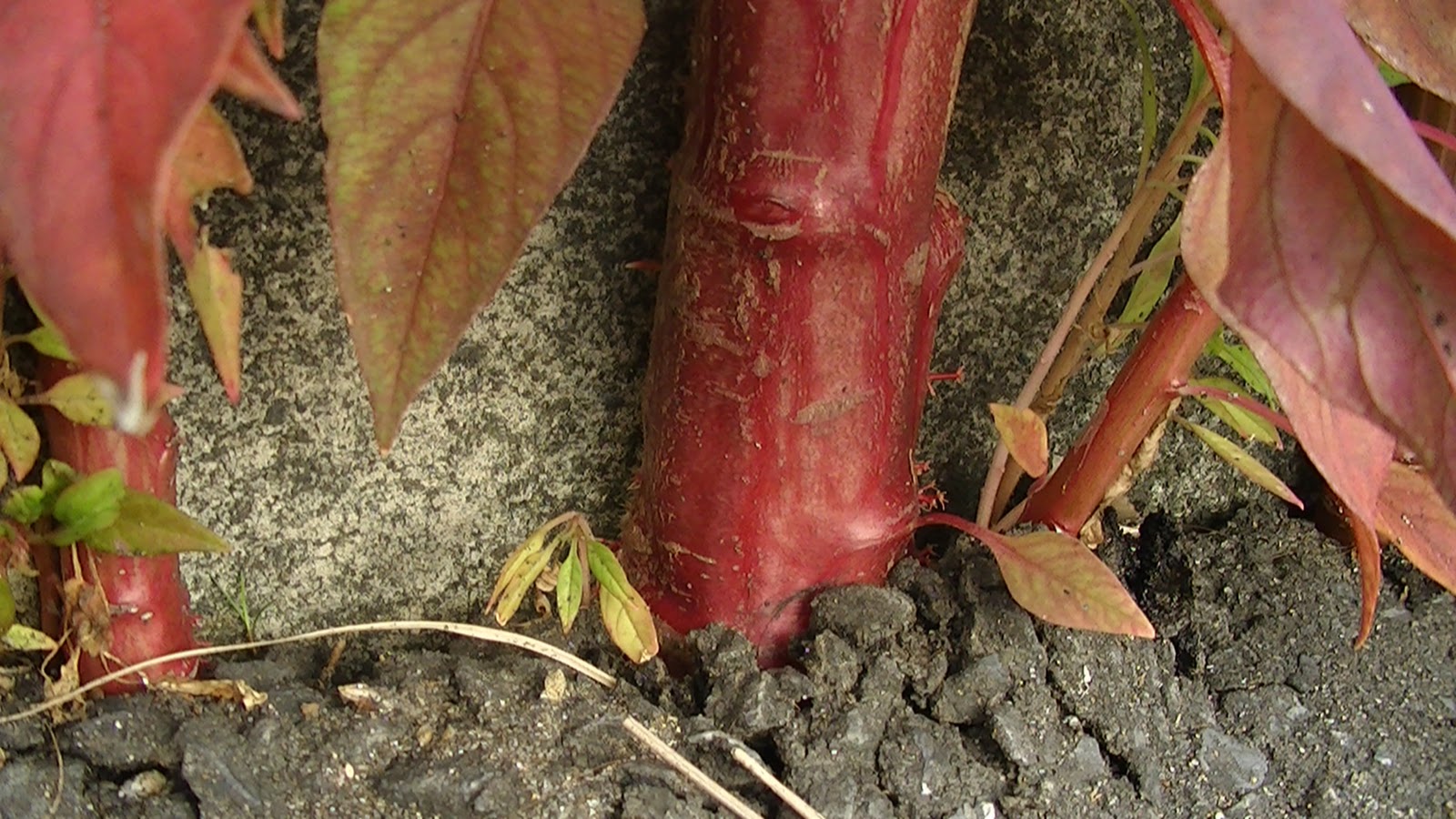

Yup--that is cock's comb, the popular backyard garden plant. Taller than my daughter.
And though it may look artfully arranged there around O-Jizo Sama, I don't think anybody planted it on purpose in the crack between that step and the parking lot asphalt.

Makes a nice visual metaphor for perseverance, don't you think?
Here's a closer look at O-Jizosama (below):

Unusually for O-Jizosama, he has several pair of arms behind, and not what I'd call
a beatific expression:))
Lots of people in our hurried modern-day world tell themselves they need to "stop and smell the roses". So they look around, don't see any roses or smelly flowers, and hurry on with their busy-ness, never noticing the strong, persistent life beneath their feet. To that I say--get thyself a field book! Those plants have names, too:))
Mata asobou, ne!
p.s.--I found last week's Yabukarashi coming up out of a crack next to the bus depot.

Gambare, Yabukarashi!

...Never say die!
Thursday, October 14, 2010
My Favorite Song
I've been meaning to put up this Angela Aki video for a while, and after watching the video of brave Joel Burns at PZ Meyer's Pharyngula, now is the time. If you've never heard of her, she's a Japanese-American singer/songwriter who's become popular recently in Japan. I loved this song the first time I heard it, even though I couldn't catch all the words. Hat tip to Sagwaneem, whose channel I've borrowed this from, for the beautiful English translation below.
This song is for Joel Burns. This song is for Dan Savage, who started the It Gets Better movement. This song is for every teenager who's ever been, or is being, bullied for the crime of simply being who they are.
The title of the song is "The Letter", written by Angela Aki, addressed to her 15-year-old self.
English Translation:
Dear you,
Who's reading this letter
Where are you and what are you doing now?
For me who's 15 years old
There are seeds of worries I can't tell anyone
If it's a letter addressed to my future self,
Surely I can confide truly to myself
Now, it seems that I'm about to be defeated and cry
For someone who's seemingly about to disappear
Whose words should I believe in?
This one-and-only heart has been broken so many times
In the midst of this pain, I live the present
Dear you,
Thank you
I have something to tell the 15-year-old you
If you continue asking what and where you should be going
You'll be able to see the answer
The rough seas of youth may be tough
But row your boat of dreams on
Towards the shores of tomorrow
Now, please don't be defeated and please don't shed a tear
During these times when you're seemingly about to disappear
Just believe in your own voice
For me as an adult, there are sleepless nights when I'm hurt
But I'm living the bittersweet present
There's meaning to everything in life
So build your dreams without fear
Keep on believing
Seems like I'm about to be defeated and cry
For someone who's seemingly about to disappear
Whose words should I believe in?
Please don't be defeated and please don't shed a tear
During these times when you're seemingly about to disappear
Just believe in your own voice
No matter era we're in
There's no running away from sorrow
So show your smile, and go on living the present
Go on living the present
Dear you,
Who's reading this letter
I wish you happiness
This song is for Joel Burns. This song is for Dan Savage, who started the It Gets Better movement. This song is for every teenager who's ever been, or is being, bullied for the crime of simply being who they are.
The title of the song is "The Letter", written by Angela Aki, addressed to her 15-year-old self.
English Translation:
Dear you,
Who's reading this letter
Where are you and what are you doing now?
For me who's 15 years old
There are seeds of worries I can't tell anyone
If it's a letter addressed to my future self,
Surely I can confide truly to myself
Now, it seems that I'm about to be defeated and cry
For someone who's seemingly about to disappear
Whose words should I believe in?
This one-and-only heart has been broken so many times
In the midst of this pain, I live the present
Dear you,
Thank you
I have something to tell the 15-year-old you
If you continue asking what and where you should be going
You'll be able to see the answer
The rough seas of youth may be tough
But row your boat of dreams on
Towards the shores of tomorrow
Now, please don't be defeated and please don't shed a tear
During these times when you're seemingly about to disappear
Just believe in your own voice
For me as an adult, there are sleepless nights when I'm hurt
But I'm living the bittersweet present
There's meaning to everything in life
So build your dreams without fear
Keep on believing
Seems like I'm about to be defeated and cry
For someone who's seemingly about to disappear
Whose words should I believe in?
Please don't be defeated and please don't shed a tear
During these times when you're seemingly about to disappear
Just believe in your own voice
No matter era we're in
There's no running away from sorrow
So show your smile, and go on living the present
Go on living the present
Dear you,
Who's reading this letter
I wish you happiness
Tuesday, October 12, 2010
Just Say Stats, Mom
My mother cannot, to save her life, pronounce the word "statistics" without tripping or spitting. Most people don't like stats much, even though it feels like we are awash in them sometimes. I used to feel that way myself--that statistics were being used, more often than not, to misinform, to hide the truth. Until I saw Hans Rosling speak on TED (down in links).
The following has nothing whatsoever to do with Japan, but may be loosely correlated with parenting. Anyway, I said down there in my profile that I occasionally write about things that have nothing to do with anything. And this is one of those occasions. Besides--I simply adore this man. He is brilliant, forthright, and his statistics are crystal clear--and utterly amazing. Here is his most recent talk given at TED (he has given three others--watch them all and be amazed):
Enjoy. And learn how to pronounce "statistics".
The following has nothing whatsoever to do with Japan, but may be loosely correlated with parenting. Anyway, I said down there in my profile that I occasionally write about things that have nothing to do with anything. And this is one of those occasions. Besides--I simply adore this man. He is brilliant, forthright, and his statistics are crystal clear--and utterly amazing. Here is his most recent talk given at TED (he has given three others--watch them all and be amazed):
Enjoy. And learn how to pronounce "statistics".
Monday, October 11, 2010
Monday Manglish-Baseball
Today's Manglish I found on the side of a baseball arcade game at the batting center. Papa took us all to have a go a batting, and though I wasn't really in the mood, I went along anyway. Who knew I'd find this treasure of a Manglish tucked away upstairs!
 "This nostalgic game machine for which everyone was waiting. Appearance from ATLUS
Desire in the interior of your chest is sure to be woken up."
Desire in the interior of your chest? Oh dear, bilingual dictionaries can be useful...or very, very dangerous if you don't speak the language("I will not buy this tobacconist...").

Desire in the interior of your chest is sure to be woken up."
Desire in the interior of your chest? Oh dear, bilingual dictionaries can be useful...or very, very dangerous if you don't speak the language("I will not buy this tobacconist...").
Saturday, October 9, 2010
Run The Other Way
The most frightening sight I've ever been confronted with in Japan is this:
Two women of a certain age walking towards me, wearing modest skirts, beige hose, sensible shoes, and carrying large handbags...
Yes, the Jehovah's Witnesses have made converts of a few Japanese as well, and they go door to door, handing out the same tracts they do everywhere else. Are they some sort of cosmological constant?
I say this in spite of the fact that I have a Japanese friend who is a Witness. She lived in Texas (where her married daughter lives still with the grandchildren), so she speaks English well. In fact, I'm pretty sure that's why she gets sent to canvass certain areas, so they don't have to walk away from a household where no Japanese is spoken. Since she and I have experiences in common, it's always mutually agreeable to converse about those and any of several interests we share. She is extraordinarily generous and kind--she never stops by without some herbs from her garden, or some hydrangeas, or a couple of lemons from her tree. Or tracts. And that's the thing--I consider her a friend, whether we agree on religious issues or not. But the reverse, I think, is not true. I'm fairly certain that she's been told to stick to her script and not get too friendly with a non-witness who doesn't appear to want to convert, or even discuss the bible much. I wonder whether she sees how divisive that attitude really is.
A post over at The Atheist Rabbi brought this into my mind all of a sudden. He put up a YouTube video of a Life of Brian scene that I hadn't seen in ages. One of my favorites from that film, in fact, and one that reminds me of my Witness friend who lectured me from the Witness book "What Does the Bible Really Teach?" about how we're all supposed to run around using the Lord's name! Some industrious Witness had in fact counted the number of times in the Hebrew Bible the Tetragrammaton appears ("nearly 7,000 times!"). When she got to that bit, I chewed my lip, kept my peace, and let this scene run through my head:
So, bad news if you were thinking of emigrating to Japan to escape the Mormons (yup--they're here, too) and the Jehovah's Witnesses. But I can tell you how to identify them from a distance without binoculars...:))
Two women of a certain age walking towards me, wearing modest skirts, beige hose, sensible shoes, and carrying large handbags...
Yes, the Jehovah's Witnesses have made converts of a few Japanese as well, and they go door to door, handing out the same tracts they do everywhere else. Are they some sort of cosmological constant?
I say this in spite of the fact that I have a Japanese friend who is a Witness. She lived in Texas (where her married daughter lives still with the grandchildren), so she speaks English well. In fact, I'm pretty sure that's why she gets sent to canvass certain areas, so they don't have to walk away from a household where no Japanese is spoken. Since she and I have experiences in common, it's always mutually agreeable to converse about those and any of several interests we share. She is extraordinarily generous and kind--she never stops by without some herbs from her garden, or some hydrangeas, or a couple of lemons from her tree. Or tracts. And that's the thing--I consider her a friend, whether we agree on religious issues or not. But the reverse, I think, is not true. I'm fairly certain that she's been told to stick to her script and not get too friendly with a non-witness who doesn't appear to want to convert, or even discuss the bible much. I wonder whether she sees how divisive that attitude really is.
A post over at The Atheist Rabbi brought this into my mind all of a sudden. He put up a YouTube video of a Life of Brian scene that I hadn't seen in ages. One of my favorites from that film, in fact, and one that reminds me of my Witness friend who lectured me from the Witness book "What Does the Bible Really Teach?" about how we're all supposed to run around using the Lord's name! Some industrious Witness had in fact counted the number of times in the Hebrew Bible the Tetragrammaton appears ("nearly 7,000 times!"). When she got to that bit, I chewed my lip, kept my peace, and let this scene run through my head:
So, bad news if you were thinking of emigrating to Japan to escape the Mormons (yup--they're here, too) and the Jehovah's Witnesses. But I can tell you how to identify them from a distance without binoculars...:))
Friday, October 8, 2010
Friday Field Notes--Entangled
I've seen this vine every year since coming to Japan, often with a particular, very large, black butterfly fluttering around it. The one who wouldn't sit still last week . You'd think I'd have looked it up earlier, but that's what comes of not having a flower book until last summer. It's called "Yabukarashi" (Cayratia Japonica). I think most people see it as a weed, but up close, it's lacy and beautiful. See?
 Here it has made the air conditioner it's own...
But look closer... ooh!

 ...and closer still. A humble green vine adorned with lacy filigree. And butterflies like it--an added bonus.
 ...and if you look very closely, you can see the flowers that the butterflies must have been drinking from. Itty, wee, pale pink things. Every year this vine takes over some body's bicycle, at least until the grass-cutters come and pull everything up by the roots. I never see this without thinking of that Haiku...
 ...the one that goes
morning glory!
the well bucket-entangled
I ask for water
by chiyo-ni, considered the greatest female Haiku poet.


Yabu Karashi!
the bicycle--entangled
I walk to work
Here is the beautiful woodcut by Utagawa depicting Chiyo-ni beside the entangled bucket...
 ....lovely, no?
Mata asobou, ne!
p.s.--Here's the butterfly who (usually) likes the Yabukarashi vine. I found him paying a visit to the first graders' morning glories at school (though they're nearly done now):
 Now that I look at him, (and at Koshi's bug book), this is Benimon Agehachou--a species originally from Okinawa that migrated to Honshu in 1968. *Not* the same as last week's! Retraction! Benimon (pachliopta aristolochiae, or Common Rose) is a swallowtail (clearly), and the one I chased down to the ginko tree last week was *not* a swallowtail, and had red spots on the top wings, so....Nagasaki Ageha papilio memnon, "Great Mormon" in English, though I've no idea why). And, looking more closely at the bug book--the black butterfly I usually see hovering about Yabukarashi is (nearly) completely black Jakkou Agaha, at 50-60mm he's quite spectacular. He's one of the "Windmill" group mostly found in India and China (hence the English common name "Chinese windmill"), although this subspecies, atrophaneura alcinous,is also found in Japan.
Can p.s.'s be this long?

But look closer... ooh!

 ...and closer still. A humble green vine adorned with lacy filigree. And butterflies like it--an added bonus.

morning glory!
the well bucket-entangled
I ask for water
by chiyo-ni, considered the greatest female Haiku poet.


Yabu Karashi!
the bicycle--entangled
I walk to work
Here is the beautiful woodcut by Utagawa depicting Chiyo-ni beside the entangled bucket...
 ....lovely, no?
Mata asobou, ne!
p.s.--Here's the butterfly who (usually) likes the Yabukarashi vine. I found him paying a visit to the first graders' morning glories at school (though they're nearly done now):

Can p.s.'s be this long?
Wednesday, October 6, 2010
Recipie for a Chilly Day--Tonjiru
As soon as it cools off enough that hot soup would taste good for dinner, and you're in a mood to try something a little different (but not too different), Tonjiru is just the thing. Put this somewhere where you'll see it and not forget (I forget everything unless it's right in front of my face). A very easy-to-make soup, the first time I ever ate Tonjiru was at my kids' elementary school at the Matsuri (festival) in November. The sixth graders make it every year with sweet potatoes they've grown and harvested themselves. There are a number of things you could put in it, but I make the simplest version for myself.
It consists, at the simplest, of five ingredients:
 Pork, half a Daikon radish, an onion (or two), a carrot (or two), and miso (the brown stuff in the box).
Other people put in potatoes or sweet potato, or gobo, but I like the simple taste best.
1) Brown the thin-sliced pork in a tablespoon of oil in the bottom of the stock pot
2) Slice the onion (in half on the meridian, then in chunks) and throw that in. When the onion looks pretty well heated,
3) Throw in the peeled and cut up Daikon and carrot. The Daikon can be cut into half-inch rounds, then the rounds cut in half or in quarters. As you like. Same for the carrot(s). And if you have kiddies, here's what I used to do:
 The carrot is cut in quarter-inch thick coins. Then get out the cute cutters, and cut a bunch of shapes for the little ones to discover in their soup:))

Kawaii, desho! (Cute, isn't it!)
I put in the shapes and the anti-shapes (mottainai!)
 ...and, of course, you can do the same with the Daikon with bigger size cutters. I used Maple Leaf and Ginko Leaf since it's fall (I also have Flower and Cherry Blossom for spring--the Japanese are *way* into their seasons:))

4) Throw it all in the pot with 6 or so cups of water (to cover the vegetables and then some), and put the fire on medium. After it comes to a boil, turn the fire down lower and once or twice skim the scum that rises to the surface:
 I have a skimmer (?...no English word that I know of for this kitchen implement) to do this. Chanto aku wo totte, ne! (Get all that scum off!--that would be your Japanese grandma talking to you). I never observed my mother doing this, but this step is in every soup-type recipe in Japan I have ever seen, and I always see this done on cooking shows (and my mother-in-law does it--so that clinches it, doesn't it!)
After the scum is skimmed, use your big ladle to get 3 to 4 tablespoons of miso (you can dissolve it half an half--two tablespoons at a time). Submerge the ladle and use the big long O-hashi to dissolve the miso in the simmering water till it's all dissolved. Put the lid on, and the fire down as low as it'll go and leave it simmering for a while. An hour is plenty. Stick your o-hashi into the middle of a piece of daikon to check. If it goes right through and the daikon is nice and soft, it's done.
And when everybody comes in--soup! You can make rice to go with it, but it tastes just as good with nice fresh bread or rolls. And it tastes even better the next day--for breakfast,even, if there's been a cold snap during the night and you wake up to frost on the windows. And for miserable sore-throat colds, nice salty miso soup is just the thing:)
Hai, dozo! Itadakima--su!
It consists, at the simplest, of five ingredients:

Other people put in potatoes or sweet potato, or gobo, but I like the simple taste best.
1) Brown the thin-sliced pork in a tablespoon of oil in the bottom of the stock pot
2) Slice the onion (in half on the meridian, then in chunks) and throw that in. When the onion looks pretty well heated,
3) Throw in the peeled and cut up Daikon and carrot. The Daikon can be cut into half-inch rounds, then the rounds cut in half or in quarters. As you like. Same for the carrot(s). And if you have kiddies, here's what I used to do:


Kawaii, desho! (Cute, isn't it!)
I put in the shapes and the anti-shapes (mottainai!)


4) Throw it all in the pot with 6 or so cups of water (to cover the vegetables and then some), and put the fire on medium. After it comes to a boil, turn the fire down lower and once or twice skim the scum that rises to the surface:

After the scum is skimmed, use your big ladle to get 3 to 4 tablespoons of miso (you can dissolve it half an half--two tablespoons at a time). Submerge the ladle and use the big long O-hashi to dissolve the miso in the simmering water till it's all dissolved. Put the lid on, and the fire down as low as it'll go and leave it simmering for a while. An hour is plenty. Stick your o-hashi into the middle of a piece of daikon to check. If it goes right through and the daikon is nice and soft, it's done.
And when everybody comes in--soup! You can make rice to go with it, but it tastes just as good with nice fresh bread or rolls. And it tastes even better the next day--for breakfast,even, if there's been a cold snap during the night and you wake up to frost on the windows. And for miserable sore-throat colds, nice salty miso soup is just the thing:)
Hai, dozo! Itadakima--su!
Monday, October 4, 2010
Monday Manglish
Today's Manglish was also found on a girl's tshirt which I fortuitously spotted at Daiei a couple of days ago. I notice that really wonderful Manglish like this tends to be on children's clothing, unfortunately. If it came in my size, you'd see me walking around with a slogan this silly pasted across my chest:

It's not the bit about "Our Feelings are Made Known To The World". Above that, in pink. The bit about "My prayer will Flap and Reach the distance". Oh, will it now? I had no idea that prayers could be described as "flapping" as they make their way to heaven, although if the author of the above had ever read of a prayer "winging its way to heaven", he or she could be forgiven for assuming that "flapping" would be a perfectly acceptable verb to use with the noun "Prayer"... :))

It's not the bit about "Our Feelings are Made Known To The World". Above that, in pink. The bit about "My prayer will Flap and Reach the distance". Oh, will it now? I had no idea that prayers could be described as "flapping" as they make their way to heaven, although if the author of the above had ever read of a prayer "winging its way to heaven", he or she could be forgiven for assuming that "flapping" would be a perfectly acceptable verb to use with the noun "Prayer"... :))
Subscribe to:
Posts (Atom)